
If you’ve applied for a job in the last six months and received an automated rejection within minutes, you haven't just been "ghosted"—you've been "parsed."
In the 2026 job market, 95% of Fortune 500 companies and 70% of mid-sized firms use an Applicant Tracking System (ATS). But here is the catch: the ATS of 2026 is lightyears ahead of the primitive keyword-matching software of the early 2020s. Today, we live in the era of Semantic Search and Intent Matching.
If your CV is still built around "keyword stuffing," you are failing. Modern AI-driven recruitment tools like Workday AI, Greenhouse Intelligence, and Lever’s Agentic Sourcing now read your CV like a human would—evaluating context, career trajectory, and transferable skills rather than just character strings.
This authority guide is your blueprint for navigating this new digital gatekeeper. We will break down exactly how to format, write, and optimize your CV to ensure it doesn't just "pass" the ATS, but ranks at the very top of the recruiter’s dashboard.
The Evolution of the Gatekeeper: ATS in 2026
To beat the machine, you must understand the machine. In 2026, the ATS has transitioned from a simple "File Organizer" to a sophisticated "Decision Support Agent."
From Keywords to Vector Embeddings
In the past, if a job description asked for "Project Management" and you wrote "Project Lead," an old ATS might have rejected you. Today, systems use Vector Embeddings. They understand that a "Project Lead" in a fintech startup likely has the same core competencies as a "Project Manager" in a banking environment. This means you no longer need to obsess over every single synonym, but you do need to provide enough context for the AI to "vectorize" your experience accurately.
Semantic Intent Matching
Modern ATS platforms now perform Intent Matching. This means they look for the "why" and "how" behind your bullet points. They analyze:
- Topical Authority: Does your entire work history support your claim of being an expert in your field?
- Career Velocity: How quickly have you progressed and taken on more responsibility?
- Skill Proximity: If you know Python, the system assumes a certain level of familiarity with data structures and backend logic, even if you don't list them explicitly.
The Technical Foundation: Formatting for 100% Parsing Accuracy
Before the AI can "read" your intent, the parser must "extract" your text. If the extraction fails, your intent doesn't matter.
The Single-Column Gold Standard
Despite the rise of "Creative CVs" on social media, the Single-Column Layout remains the safest choice in 2026.
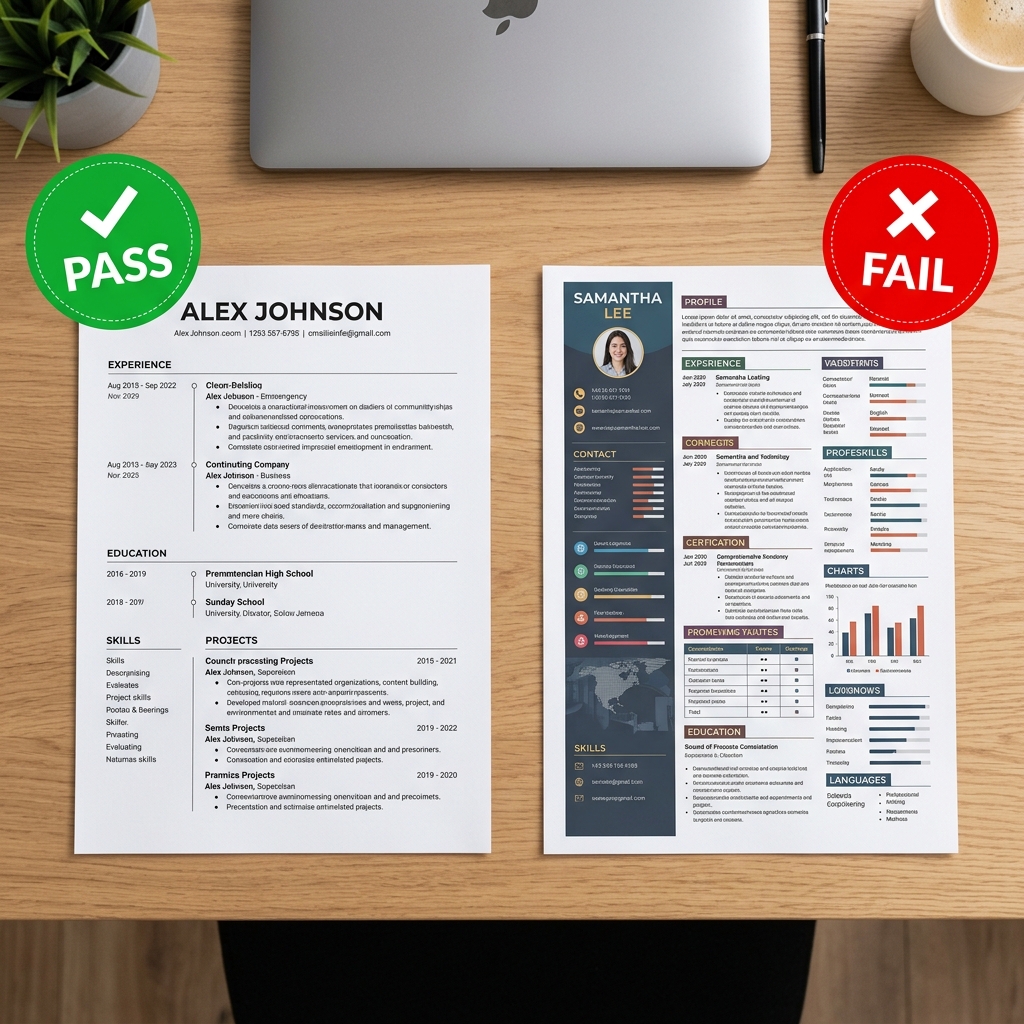
Multi-column layouts, tables, and sidebars often confuse the "Reading Order" of the parser. A parser might read the left column and then the right column, or worse, read across the columns, turning your professional experience and education sections into a garbled mess of text.
The Problem with Tables and Graphics
ATS parsers work by converting your PDF or Word document into a plain text file. Graphics, icons, and progress bars (e.g., "SQL: 80%") are invisible to the machine. Tables often "break" the text extraction, causing your dates to be associated with the wrong companies.
Machine-Readable Typography
In 2026, use standard, web-safe fonts. While AI is better at reading custom fonts, why take the risk?
- Recommended Sans-Serif: Inter, Roboto, Open Sans.
- Recommended Serif: Merriweather, Georgia.
- Avoid: Script fonts, overly stylized display fonts, or light-weight fonts that disappear during low-resolution parsing.
If you want to skip the technical headache, our ATS-Optimized CV Builder uses proprietary layouts that have been tested against every major 2026 ATS vendor to guarantee a 100% parsing score.
Mastering Semantic Keywords
In 2026, "Keyword Stuffing" is a red flag. If your CV has a hidden "Keywords" section in white text (a common early-decade hack), modern systems will flag your profile as "Low Trust" or "Attempted Manipulation."
Strategic Keyword Integration
Instead of listing skills in a vacuum, integrate them into your Experience section.
Old Way (Bad): "Skills: JavaScript, React, Node.js"
New Way (Semantic): "Spearheaded the development of a high-traffic e-commerce platform using React and Node.js, resulting in a 30% reduction in server-side latency."
By placing the keyword next to an action and a result, you provide the "Context" the AI needs to verify your proficiency level.
The Power of "Adjacent Skills"
Because 2026 ATS uses semantic search, you should include skills that are conceptually related to your target role. If you are a Data Scientist, including "Statistical Modeling" and "Data Visualization" is expected, but adding "Business Stakeholder Communication" shows the AI that you can apply those technical skills in a corporate context.
Writing for the "6-Second Human" and the "Millisecond Machine"
Once the ATS ranks you, a human recruiter will spend roughly 6 seconds looking at your CV before deciding to call you. You must balance machine-readability with human persuasion.
The Professional Summary: Your Elevator Pitch
Your summary should be 3-4 sentences that act as a meta description for your career.
- Sentence 1: Who you are + Years of experience.
- Sentence 2: Your "Superpower" or primary specialized skill.
- Sentence 3: Your biggest career achievement.
- Sentence 4: What you are looking to do next (Tailored to the job).
The STAR-Impact Method for 2026
Every bullet point in your experience section must demonstrate impact. Using the STAR-Impact method ensures that you provide the machine with the context it needs while wowing the human recruiter.
Example: Marketing Manager Achievement
Situation: The company's multi-channel ad spend was underperforming with a $2M budget, leading to high acquisition costs.
Task: I was tasked with auditing the entire funnel and optimizing the return on ad spend (ROAS) across five platforms.
Action: I implemented a new AI-driven attribution model and shifted 40% of the budget to high-intent search campaigns while redesigning the landing page UI.
Result: This led to a 45% increase in ROAS and a 12% decrease in customer acquisition cost over 12 months.
Impact: My strategy added £1.2M in annual recurring revenue (ARR) and established a scalable growth framework for the next fiscal year.
If you have gaps in your timeline, learning how to explain a career gap due to burnout can help you frame that time as a period of professional growth and resilience.
The Semantic Search Visualization
Understanding how the AI "sees" your CV can help you write it better.

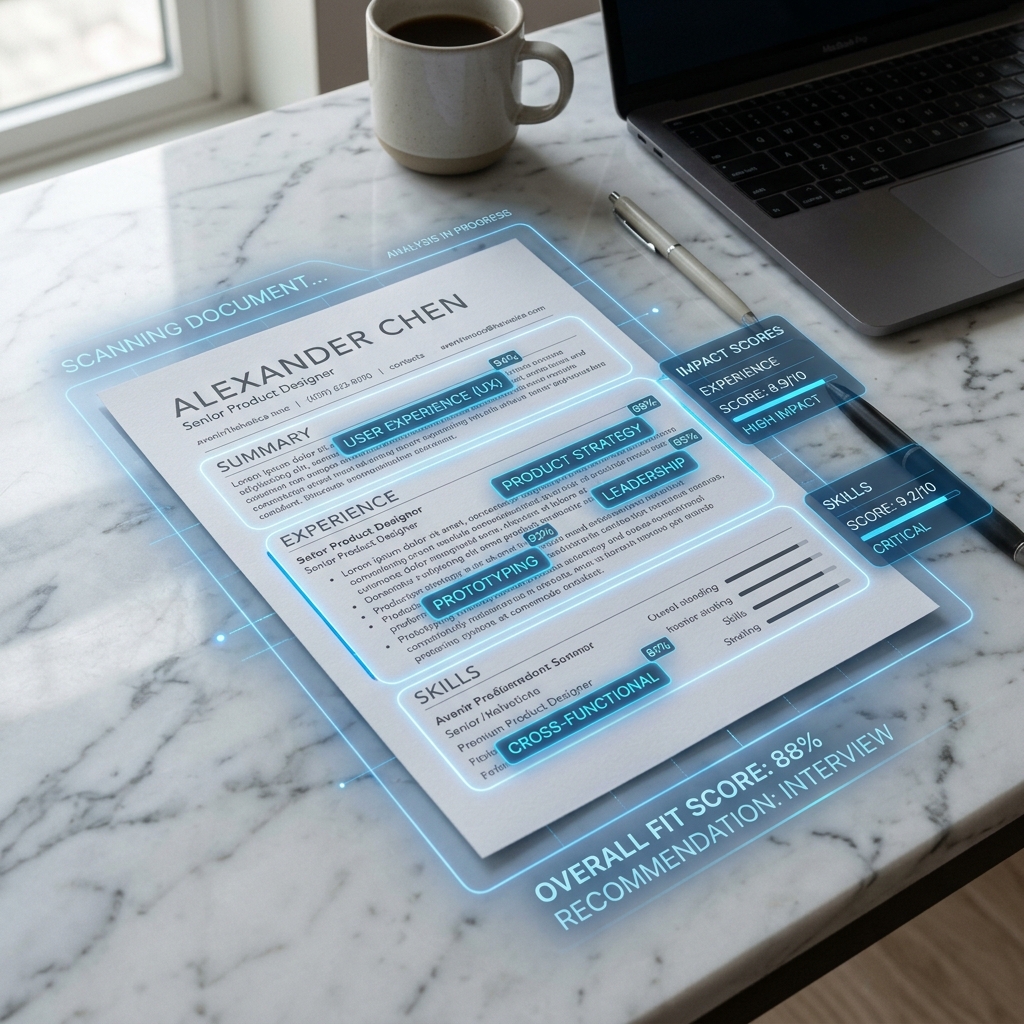
As shown in the visual above, the 2026 ATS doesn't see "words"; it sees Concepts. When you write about "Leading a team of 10," the AI tags you with concepts like Leadership, Resource Allocation, Project Management, and Conflict Resolution. This is why Specificity is your greatest weapon.
Role-Specific ATS Strategies
1. Technical and Engineering Roles
In 2026, tech recruiters are looking for "Skill Stacks" and "Architectural Thinking." Beyond listing languages, you should show how you solved scale problems. When preparing for software engineer interview questions, remember that your CV is the first proof of your technical logic.
2. Management and Leadership Roles
AI-ATS for management roles focuses on "People Metrics" and "Strategic Impact." Use keywords like Stakeholder Management, P&L Responsibility, and Cross-functional Leadership. Our Product Manager CV Guide goes into deeper detail on how to rank for high-level strategic roles.
3. Career Changers
If you are transitioning industries, focus on functional keywords that bridge the gap. For instance, if moving from retail to tech sales, emphasize Customer Relationship Management (CRM) and Quota Attainment. Learning how to tailor your CV to any job description is the most important skill for anyone making a significant career pivot.
The "Rejection Triggers" of 2026
Even with the best content, these mistakes will cause an "Auto-Reject":
- Header/Footer Contact Info: Some parsers still struggle to extract text from headers and footers. Keep your contact info in the main body.
- Images as Text: Never use an image to display text (like a quote or a portfolio link).
- Non-Standard Section Titles: Use "Work Experience" instead of "My Professional Journey." The machine needs standard anchors.
- Complex File Names: Use a clear format like
FirstName_LastName_Role.pdfto ensure the recruiter can find your file in their local storage easily.
Leveraging the AlignCV Ecosystem
Writing an ATS-friendly CV used to take days. With AlignCV, it takes minutes.
The AI Optimizer
Our AI CV Optimizer isn't just a spellchecker. It uses the same semantic engine as the top-tier ATS platforms. It will give you a real-time ATS Score and identify missing concept keywords based on your target job description.
The CV Builder
All of our templates are ATS-Native. This means we built the code from the ground up to ensure every character is perfectly indexable by any parser, from legacy systems to the latest 2026 AI agents.
2026 ATS Checklist (The Final 10 Points)
- Is it a single-column layout?
- Is it saved as a text-layered PDF or .docx?
- Have I avoided tables, charts, and images?
- Does my Professional Summary contain my "Superpower"?
- Are my bullet points focused on Quantifiable Impact?
- Have I used standard section headers?
- Are my keywords integrated into the experience, not just listed?
- Have I included "Adjacent Skills" to help with semantic matching?
- Is my contact information in the body of the text (not header/footer)?
- Have I run it through an AI Optimizer?
FAQ
Q: Is PDF better than Word in 2026?
A: Both are acceptable, but a Text-Layered PDF is the universal standard. It preserves your formatting for the human eye while providing a clean text layer for the machine. Even official documentation from major software providers confirms that as long as the text is selectable, the ATS can read it.
Q: Should I include a photo on my CV?
A: In the US, UK, and Canada: No. It can trigger compliance rejections due to anti-discrimination laws. In 2026, many AI-ATS will auto-reject any file containing a photo to avoid bias in the early screening stages.
Q: How many keywords is "too many"?
A: In 2026, it's not about the count; it's about the Density and Context. If you use the same keyword 20 times, it looks like spam. If you use it 3 times within 3 different achievement descriptions, it looks like expertise.
Final Thoughts: The Human Behind the Data
The ATS is a hurdle, but it is not the finish line. Your goal is to pass the machine so you can speak to the human. By optimizing for Semantic Search, you are telling the machine that you are a qualified professional, and you are telling the human that you are a person of impact.
Your next career move is too important to leave to chance.
Try Our AI CV Optimizer Now and see exactly how the machines see you.
Ready to build your perfect CV?
AlignCV helps you create ATS-friendly CVs and tailored cover letters with AI.
Create Your CV NowWritten by
Mehmet Kerem Mutlu
Founder of AlignCV · Mechanical Engineering Student
Mehmet Kerem is a mechanical engineering student and the founder of AlignCV — an AI-powered career platform built to help every job seeker land their next role with confidence. Combining his engineering mindset with a passion for product development, he designs tools that make CV writing, cover letter generation, and interview preparation faster and smarter. He writes about career strategy, AI in hiring, and the future of work.