

Top 10 Software Engineer Interview Questions and How to Answer Them (2026)
Picture this. You have passed the recruiter screen, your CV made it through the ATS, and now you are sitting in a technical interview at a company you actually want to work for. The interviewer looks at you and asks: "Can you walk me through how you would design a scalable messaging system?"
Do you freeze, or do you have a framework ready?
Most engineers who struggle in interviews do not struggle because they lack technical knowledge. They struggle because they have not thought about how to communicate that knowledge under pressure. The gap between a strong engineer and a successful interviewee is rarely about skills. It is almost always about preparation.
Research from platforms like interviewing.io consistently shows that technical competence only gets you partway there; communication and structured thinking often determine the final hiring decision.
This guide covers the ten most common software engineer interview questions you will face in 2026, broken into technical, system design, and behavioural categories. For each one, you will get the question, what the interviewer is actually evaluating, and an example answer that shows the approach that works.
How software engineer interviews are structured in 2026
Before getting into individual questions, it helps to understand what you are preparing for. Most software engineering interviews in 2026 follow a similar structure across companies:
- Phone/video screen (30 to 45 minutes): Often a recruiter or hiring manager call. You may get one straightforward coding problem or a walkthrough of your CV.
- Technical rounds (one or more sessions): Live coding, algorithm questions, system design. Expect to talk through your thinking in real time. (Practising in a realistic environment, like an AI-powered mock interview, is the fastest way to get comfortable with this).
- Behavioural round: Structured questions about how you have worked in the past, handled conflict, and made decisions. Many companies weight this as heavily as the technical round.
- Hiring manager round: More open-ended conversation about the role, your career, and team fit.
Being weak in any one of these areas can end an otherwise strong application. The questions below cover all three main categories.

Technical questions
Question 1: Tell me about yourself
This is almost always the first question, and it is almost always answered badly. Most candidates either give a full CV walkthrough (too long) or a vague two-liner that tells the interviewer nothing useful.
What the interviewer wants: A clear summary of who you are as an engineer, what you have been working on, and why you are interested in this role specifically. They want to know you can communicate concisely under mild pressure.
How to answer it: Use the three-part structure: where you have come from, what you are doing now, and what you are looking for. Keep it to 90 seconds or under.
I am a backend engineer with four years of experience, most recently at a fintech startup where I was the lead engineer on our payments microservice. We moved from a monolithic Rails app to a distributed Go service and reduced our p95 latency from 800ms to around 120ms in the process. Before that I spent two years at an agency mostly building APIs for e-commerce clients. I am looking for a role where I can take more ownership across the full system lifecycle, not just the backend layer. This role stood out because of the scale involved and the cross-functional structure.
Notice what is in there: concrete technologies, a real outcome with numbers, and a specific reason for interest in this role. That is what makes an answer memorable.
Question 2: Explain the difference between a process and a thread
This is a classic fundamentals question that comes up across most technical screens. It tests whether you understand how modern systems actually run.
What the interviewer wants: Not a dictionary definition, but a practical understanding. Can you explain this clearly to a colleague? Can you give an example of when the distinction matters?
How to answer it: Cover the core distinction, then add context.
A process is an independent instance of a running programme. It has its own memory space, its own file descriptors, its own execution context. Processes are isolated from each other by the operating system, which means one crashing process typically cannot corrupt another. A thread, on the other hand, lives inside a process and shares that process's memory. Multiple threads within a process can read and write to the same data, which makes them faster to communicate but also harder to reason about correctly. The trade-off is that shared memory creates the risk of race conditions if you are not careful with synchronisation. In practice, if you are building something like a web server handling multiple concurrent requests, threads are often the right tool because the overhead of spinning up a new process per request would be too high. But for something where isolation matters, like sandboxed user code execution, separate processes make more sense.
This answer demonstrates not just knowledge, but the ability to reason about trade-offs — which is what engineering is.
Question 3: What is time complexity, and how do you use Big O notation?
This appears in almost every technical interview. It seems simple, but how you answer it reveals a lot about how you think about code quality.
What the interviewer wants: An understanding that is connected to practical consequences. As noted in classic computer science resources like GeeksforGeeks, interviewers are not looking for a textbook definition. They want to know you actually think about efficiency when you write code.
How to answer it:
Time complexity is a way of describing how the runtime of an algorithm grows as the size of the input grows. Big O notation gives us a language for that — O(n) means the runtime grows linearly with input size, O(log n) means it grows logarithmically, O(n²) means each additional input adds work proportional to the current total size. I use it practically when I'm choosing data structures or designing queries. If I know I am going to be doing a lot of lookups, I reach for a hash map over a list because the lookup is O(1) rather than O(n). If I see nested loops in a code review, my first instinct is to ask whether there is a way to restructure it to avoid the quadratic behaviour. It matters most at scale — a function that takes 10ms on 100 records might take 10 seconds on 100,000 if the complexity is wrong.
Question 4: How would you debug a production issue?
This is a practical, scenario-based question that tests your methodology rather than your knowledge of any specific tool.
What the interviewer wants: A clear, structured process. They want to see that you do not panic and that you know how to triage systematically.
How to answer it:
My first step is always to understand the scope of the impact before touching anything. Is this affecting one user or every user? One region or globally? Is it a complete outage or a degraded state? That shapes everything else. Then I look at logs and monitoring — error rates, latency, any correlation with a recent deployment. If we shipped code in the last hour, that is my starting hypothesis until evidence says otherwise. Once I have a working theory about the cause, I follow the smallest possible path to verify it. I do not make multiple changes at once, because then I lose track of what actually fixed it. I also make sure I communicate status to stakeholders throughout, even if the update is just 'still investigating.' Engineers who go quiet for 45 minutes during an incident make everyone anxious. Once it is resolved, we do a post-mortem — not to assign blame, but to understand what failed and whether we can make it less likely or easier to detect next time.
System design questions
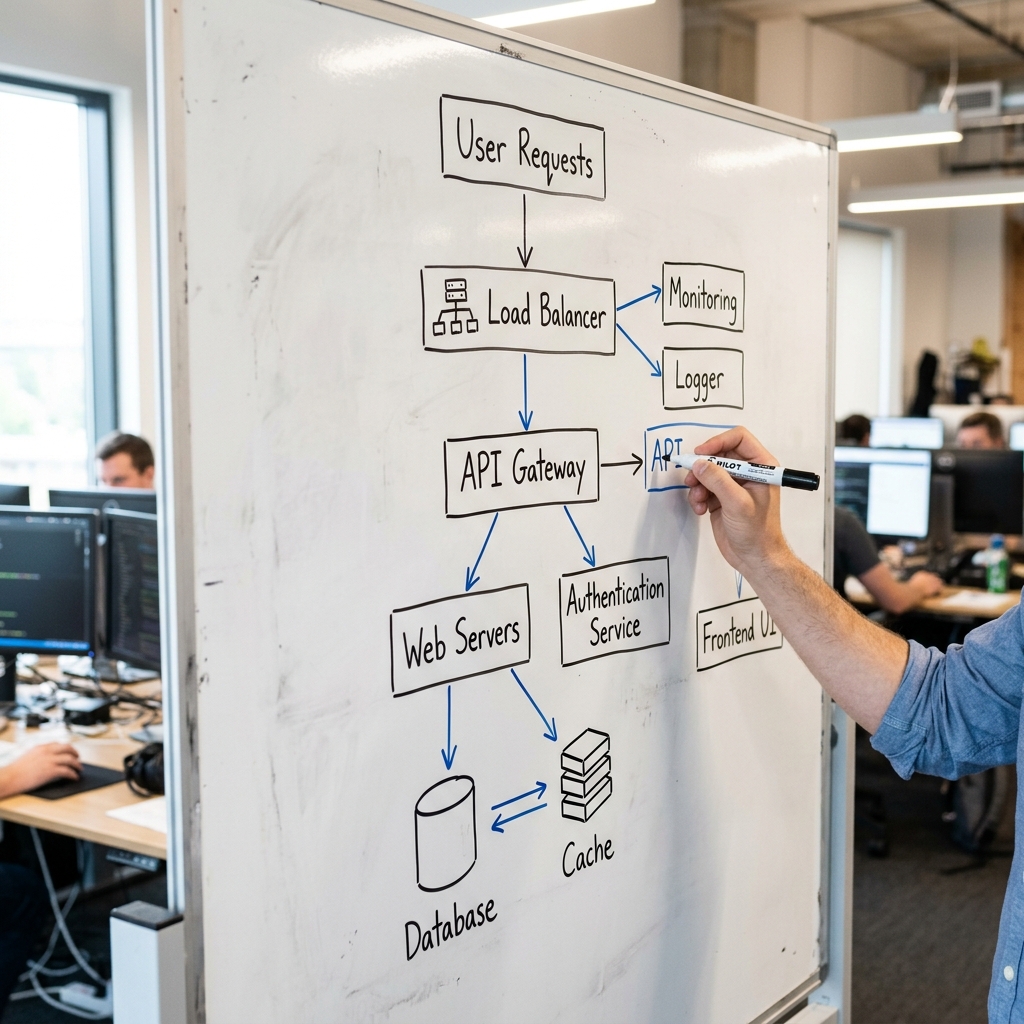
System design questions are where mid-level and senior engineers are differentiated from juniors. The goal is not to produce a perfect architecture. Concepts popularized by resources like ByteByteGo show that interviewers want to see how you reason clearly about trade-offs at scale.
Question 5: How would you design a URL shortener?
This is one of the most common system design prompts used in engineering interviews. It appears simple, which makes it a good test of how deeply you can reason.
What the interviewer wants: To see that you start by defining requirements, then think about scale before jumping to a solution. They want trade-off thinking, not a Wikipedia answer.
How to answer it:
Start with requirements, then work outward:
Before I design anything, I want to scope the problem. Are we expecting millions of URLs per day or thousands? Do we need analytics — click counts, referrers, geographic data? Do shortened URLs expire? Assuming we are targeting something like 100 million URLs per day globally with no expiry and basic analytics, here is how I would approach it.
The core job is: take a long URL, store it, generate a short code, then redirect visitors. For the short code, I would use base62 encoding of an incrementing ID — that gives us enough unique codes for decades of use without collision. Storage-wise, a simple key-value store — Redis or DynamoDB — makes sense for the redirect lookup, because it is a pure read-heavy workload and we need sub-10ms response times. The long URL gets stored in a relational database for durability and analytics queries.
For scaling, the redirect service is stateless and horizontally scalable. We put a CDN in front of it so popular URLs are cached at the edge and we avoid hitting our origin at all. The write path — generating new short URLs — is much lower volume than reads, so it does not need the same level of scaling treatment.
Trade-offs I am making: consistency is not a hard requirement here. If a newly created URL takes 100ms to propagate to all edge nodes, that is fine. So I would favour availability and performance over strict consistency.
That is the level of depth that distinguishes a strong system design answer.
Question 6: How do you decide between SQL and NoSQL?
This comes up in system design conversations, code reviews, and even behavioural rounds. It is a question about technical judgement.
What the interviewer wants: Evidence that you choose tools based on the problem, not personal preference or familiarity.
How to answer it:
It depends on what the data looks like and how it will be accessed. SQL is the right default when your data has clear relationships, when you need joins, when ACID compliance matters, or when the schema is unlikely to change frequently. Most business applications — billing, user records, order management — benefit from relational databases because the data is genuinely relational.
NoSQL makes more sense when you need horizontal scale beyond what a single relational database can handle, when your schema is genuinely flexible or evolving rapidly, or when you are storing documents or key-value pairs where joins are not part of the workload. For something like user event tracking at high volume, a document store or wide-column store is often the better fit.
In practice, most systems use both. We might have a PostgreSQL database as the source of truth for user data and a Redis cache in front of it for performance, or a Cassandra cluster for time-series event data alongside a relational database for everything else.
Behavioural questions
Behavioural questions are underestimated by most engineers. They feel softer, so candidates prepare less for them. But these questions often carry as much weight as the technical rounds, particularly at mid-to-senior levels. Use the STAR method: Situation, Task, Action, Result.

Question 7: Tell me about a time you disagreed with a technical decision
This is one of the most common behavioural questions in software engineering interviews. It tests your ability to operate effectively in a team without either rolling over or creating conflict.
What the interviewer wants: Evidence that you can raise concerns professionally, support decisions even when you disagree, and contribute constructively rather than just complaining.
How to answer it (STAR):
We were building a new data pipeline at my last company and the team decided to use MongoDB because the team lead had used it before. I had concerns that the data we were working with was actually highly relational, and I thought we were making the choice for familiarity reasons rather than based on the data's actual structure.
I put together a short written comparison of both approaches and asked for thirty minutes in our next engineering sync to go through it. I was not trying to overrule anyone — I wanted to make sure we were making the decision deliberately rather than by default.
After the discussion, the team decided to stay with MongoDB but added one relational table for the lookup queries I had flagged. It was a reasonable compromise. The system has been in production for a year and has held up well.
What I took from it was that the quality of the outcome mattered, not whether my original position won. And putting my concern in writing before the meeting made the conversation much more productive than raising it verbally in the moment.
Question 8: Describe a time you had to deliver under a tight deadline
This is a question about pressure management, decision-making, and communication — not just about whether you got the thing done.
What the interviewer wants: To see how you make trade-offs when time is constrained, and whether you communicate proactively when plans change.
How to answer it (STAR):
We had a regulatory change that required updates to our compliance reporting feature, with a hard deadline imposed by the regulator. The feature was more complex than anyone had anticipated when we scoped it, and it became clear midway through that we were not going to make the date with the full implementation.
I had a direct conversation with our product manager and the compliance team about what was actually required by the regulator versus what we had added as nice-to-haves. We identified three features that were genuinely mandated and two that were internal improvements we had bundled in. We descoped the internal improvements for the first release.
We shipped the compliant version on time, documented the descoped items in our backlog with the technical context so we did not lose the thinking, and shipped the rest three weeks later. The compliance team was satisfied, and we avoided a last-minute scramble by raising the issue three weeks before the deadline rather than three days before.
Question 9: Tell me about a time you improved a system or process
This is a question looking for engineering initiative — evidence that you think beyond the ticket in front of you.
What the interviewer wants: A concrete example with measurable before-and-after. They want to see that you can identify problems, build a case for fixing them, and see it through.
How to answer it (STAR):
Our deployment pipeline at my previous company was manual and error-prone. Deploying to production involved five manual steps documented in a Confluence page, and we had three incidents in six months that traced back to a step being skipped or done out of order.
I spent two sprint cycles building a CI/CD pipeline in GitHub Actions that automated the deploy process and added a mandatory smoke test suite that ran before traffic was routed to the new release. I presented the proposal to the team, got buy-in, and rolled it out with a two-week parallel period where we ran both the old and new process so engineers could see the difference.
In the twelve months after, we had zero deployment-related incidents. Deployment time dropped from around forty-five minutes of human attention to about eight minutes of automated work. It was one of the highest-leverage things I worked on that year, and I got a lot of my thinking for the proposal from the post-mortems we had logged.
Question 10: Where do you see your career in three years?
This question feels like small talk, but it is actually evaluated seriously. Engineers who have no answer for this signal low motivation. Engineers who give implausible answers about wanting to be a CTO in three years signal poor self-awareness.
What the interviewer wants: Evidence that you have thought about your career, that your goals are realistic, and that this role fits into them. They are also checking whether your trajectory makes sense for the team.
How to answer it:
In three years I want to be in a position where I am making meaningful technical decisions at the system level — shaping architecture, maybe leading a small team for a particular product area, not necessarily managing people in the traditional sense but bringing technical leadership to how we solve problems. I am at a point in my career where I have got the execution skills reasonably well-developed and I want to grow the part where I am thinking more strategically about what to build and why. That is part of what attracted me to this role — it seems like the kind of environment where that growth is possible if you put in the work.
What to do the day before your interview
The technical preparation matters, but so does the day-of setup. A few things worth doing:
- Research the company's tech stack — check their engineering blog, their job descriptions, their GitHub if it is public. At least two or three of your examples should reference technologies relevant to their environment.
- Prepare five STAR stories from your recent work — conflict, deadline pressure, something you built, something you fixed, something that went wrong. Most behavioural questions can be answered with this bank.
- Run through an interview out loud — simulate the pressure. The core skill is talking through your reasoning coherently. You can do this with a peer, or use AlignCV's AI mock interview tool to get instant specific feedback on your answers without the scheduling hassle.
- Have two good questions ready to ask — about the engineering culture, the team's biggest technical challenge, or how decisions get made. Candidates who ask no questions or ask about salary in the first interview leave a poor impression.
Your CV got you this far. The interview is the part that determines whether you get the offer. Preparation does not guarantee success, but it eliminates most of the ways an interview goes wrong.
Frequently asked questions
How long should my answers be in a software engineering interview?
For technical questions, keep talking through your reasoning as you work — silence is harder to evaluate than a wrong initial guess. For behavioural questions, aim for two to three minutes per answer using the STAR structure. Under a minute is too thin. Over four minutes starts to lose the interviewer.
What if I do not know the answer to a technical question?
Say so, and then reason through it. Interviewers generally respect "I have not worked with this directly, but here is how I would approach it" more than a bluff that unravels under follow-up questions. Show your thinking.
How important are LeetCode-style coding questions in 2026?
They are still present at most large tech companies for entry and mid-level roles. The emphasis has shifted somewhat toward understanding your reasoning and handling ambiguity rather than producing perfect code at speed. Communication during the coding exercise matters as much as the solution.
Should I talk about salary in a technical interview?
No. Technical and behavioural interviews are for the hiring team to assess your fit. Salary conversations belong in a dedicated conversation with the recruiter or hiring manager, ideally once you have an offer or explicit invitation to discuss it.
How much does the STAR method actually matter?
It matters significantly in behavioural rounds. Interviewers at larger companies are trained to score behavioural responses using structured rubrics. A STAR-structured answer is far easier to score well than a narrative that wanders. Practice is the only way to make it feel natural rather than mechanical.
Final thought
The most common feedback engineers receive after a failed interview is that they went silent during coding problems, or that their system design answers jumped to solutions before defining requirements, or that their stories didn't go into enough detail about what they personally did.
All of these are fixable with preparation. The interview is not a test of your intelligence. It is a test of your preparation.
Stop guessing how you sound under pressure. Start an AI-powered mock interview with AlignCV to practice these exact questions in a realistic environment. Get instant feedback on your technical communication, refine your STAR examples, and walk into your real interview knowing exactly what to say.
Practice with our AI Mock Interviewer
Simulate real interviews, get instant feedback, and build confidence before the big day.
Start PracticingWritten by
Mehmet Kerem Mutlu
Founder of AlignCV · Mechanical Engineering Student
Mehmet Kerem is a mechanical engineering student and the founder of AlignCV — an AI-powered career platform built to help every job seeker land their next role with confidence. Combining his engineering mindset with a passion for product development, he designs tools that make CV writing, cover letter generation, and interview preparation faster and smarter. He writes about career strategy, AI in hiring, and the future of work.