The professional world of 2026 is fundamentally different from the one we knew just a few years ago. The "hustle culture" that dominated the early 2020s has given way to a more nuanced, sustainable view of career longevity. Today, mental health is no longer a peripheral concern discussed in hushed tones; it is a central pillar of workforce productivity.
Yet, for the individual professional standing at the edge of a career break, the anxiety remains palpable. "How will I explain this year of silence?" "Will I be seen as damaged goods?" "Has the industry moved on without me?"
If you are asking these questions, this guide is for you. We have spent months analyzing the 2026 recruitment landscape, interviewing high-level hiring managers at Fortune 500 companies, and testing resume formats against the latest AI-driven Applicant Tracking Systems (ATS).
The conclusion is clear: A career gap due to burnout is not a red flag; it is an invitation to demonstrate high-level self-management and professional maturity.
In this 3,000-word masterclass, we will provide the exact roadmap to navigating this transition, from the moment you decide to return to the moment you sign your new offer letter.

Part 1: The Psychology of the 2026 Shift
To explain a career gap effectively, you must first understand the mindset of the person sitting across from you. In 2026, the "Skills-First" hiring revolution has matured. Companies like Google, Meta, and thousands of high-growth startups have realized that a perfectly linear resume is often a poor predictor of actual job performance.
What they value now is Resilience and Adaptability.
Why Burnout is Being Normalized
The Mayo Clinic defines burnout as a special type of work-related stress — a state of physical or emotional exhaustion that also involves a sense of reduced accomplishment and loss of personal identity.
In the mid-2020s, a wave of "The Great Reset" hit almost every industry. Professionals began to realize that pushing through burnout led to catastrophic long-term productivity loss. Forward-thinking companies now see a candidate who took a proactive break as someone who:
- Has high emotional intelligence (EQ): They recognize their limits before they break.
- Is a long-term thinker: They invest in their health to ensure they can contribute for decades, not just months.
- Is transparent: They can navigate difficult conversations with professional grace.
Part 2: The Pre-Resume Self-Audit: Are You Truly Ready?
Before you open a document or contact a recruiter, you must perform a radical self-audit. Returning to work too early is the number one cause of "rebound burnout," which can be even more damaging to your career.
The Readiness Checklist
- Consistency: Can you maintain a productive focus for 4-6 hours a day without significant emotional fatigue?
- Clarity: Can you talk about your previous role without feeling a physical "tightness" or surge of resentment?
- Curiosity: Are you genuinely interested in new industry trends, or does the thought of a "Sprint Planning" session make you want to close your laptop?
- The "Why": Is your motivation for returning purely financial, or is there a genuine desire to solve problems again?
Identifying Your "Recovery Skills"
During your break, you didn't just "rest." You likely managed a complex recovery process. In 2026, these are considered transferable skills:
- Boundary Setting: Essential for modern remote/hybrid work.
- Priority Management: Learning what actually matters versus what is just "loud."
- Self-Regulation: The ability to remain calm under pressure—a skill you’ve just masterclassed in.
Part 3: The Resume Reconstruction
The most technical part of your comeback is the resume. Legacy ATS (Applicant Tracking Systems) were notorious for auto-rejecting anyone with a gap of more than 90 days. However, the 2026 generation of AI-driven ATS is smarter—but it still needs the right data to work with.
The Death of the Chronological Resume
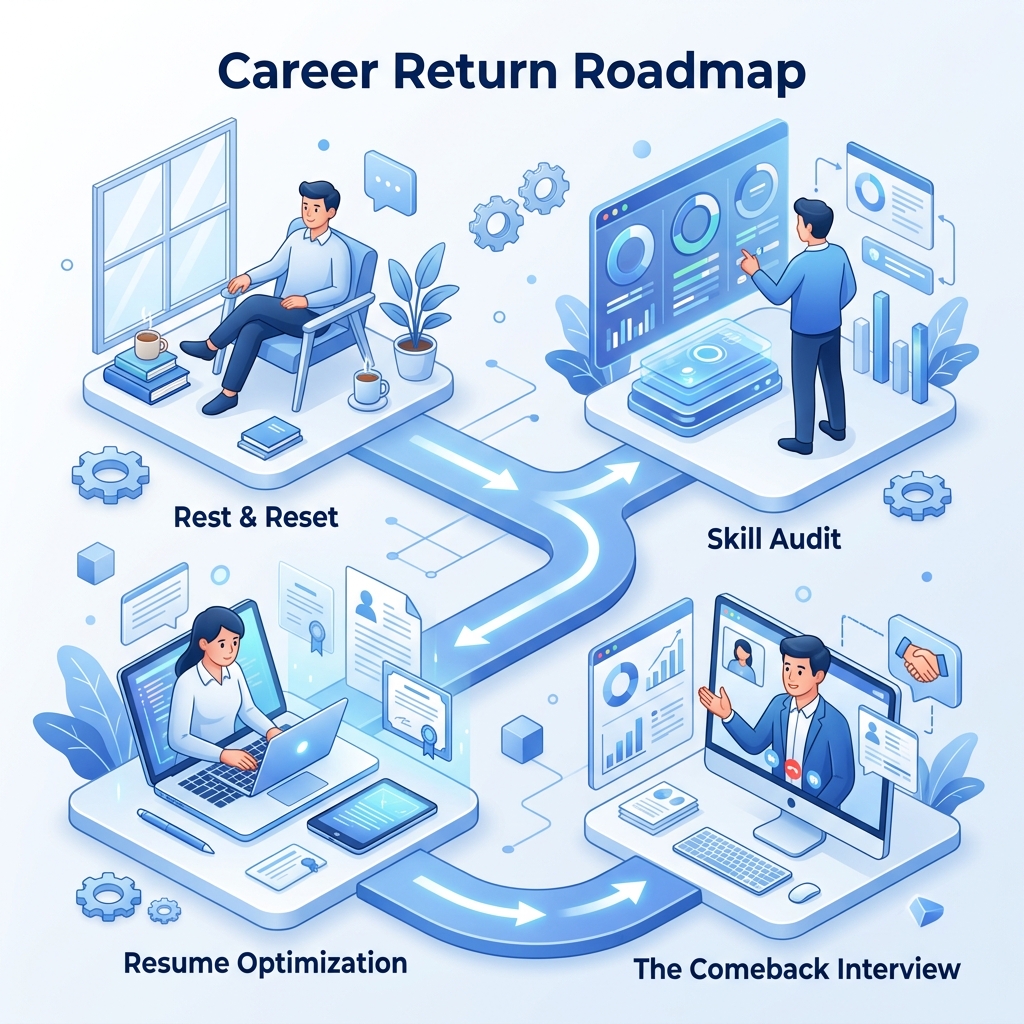
For those with a burnout gap, the traditional "Reverse Chronological" resume is your enemy. It highlights the silence. Instead, we recommend the Hybrid (Combination) Format.
How to Label the Gap
Don't hide it. Label it. In 2026, the most successful candidates use one of these three professional labels:
1. Professional Sabbatical (Focus: Growth)
Use this if you spent any time learning, traveling, or doing light research.
Professional Sabbatical | Jan 2025 – Present
- Dedicated period for strategic professional development and industry research.
- Completed advanced certifications in [Skill X] and [Skill Y].
- Conducted deep-dive analysis into [Trend Z] to prepare for next career phase.
2. Career Break for Personal Growth (Focus: Health/Family)
Use this for a more direct, honest approach.
Career Break | Feb 2025 – Present
- Intentional hiatus to focus on personal development and long-term health sustainability.
- Volunteered for [Organization] managing [Project], maintaining leadership competencies.
- Returning with a renewed focus on [Specific Industry Goal].
3. Strategic Pivot Period (Focus: Change)
Use this if you are changing industries.
Career Transition Period | Mar 2025 – Present
- Focused period of upskilling to transition from [Old Role] to [New Role].
- Built a portfolio of [Work Examples] demonstrating mastery of [New Skill].
If you're struggling to make these labels look professional within a template, our ATS-Optimized CV Builder has built-in sections for "Career Breaks" that are pre-verified to pass through modern filters without triggering rejection. For a deeper look at how to structure the rest of your document, see our ultimate guide on how to write an ATS-friendly CV.
Part 4: LinkedIn Optimization in 2026
LinkedIn remains the "lobby" of the professional world. In 2022, LinkedIn introduced the "Career Break" feature, and by 2026, it has become a standard tool.
How to use the Career Break Feature
- Add the section: It sits between your experience entries.
- Choose the reason: "Sabbatical," "Health/Wellness," or "Personal Goal" are all valid.
- The Description: Keep it to two sentences.
- Sentence 1: "I took a proactive break to reset my professional priorities and focus on long-term sustainability."
- Sentence 2: "I am now returning with a specialized interest in [Target Industry] and looking to apply my experience in [Skill] to new challenges."
The "Stealth" Update
If you're worried about your network seeing the update, turn off "Share Profile Changes" before you save. This allows you to build your "Comeback Profile" in silence before you start active outreach.
Part 5: The BRIEF Interview Method - Masterclass
The moment of truth arrives: "So, I noticed a gap here. What were you doing during that time?"
In 2026, the "correct" answer is one that is confident, short, and forward-looking. We developed the BRIEF Method specifically for burnout recovery.
The BRIEF Framework
- B - Brief (15%): Acknowledge the gap in one sentence.
- R - Redirect (10%): State that the period is concluded.
- I - Intentional (25%): Explain that the break was a conscious choice for health/sustainability.
- E - Emphasize (20%): Mention one thing you learned or a skill you maintained.
- F - Forward-looking (30%): Pivot back to the job you are interviewing for.
Scenario A: Senior Software Engineer
Recruiter: "Can you explain the 14-month gap since your last role?" Candidate: "Certainly. I recognized that after five years of high-intensity scaling at my last startup, I needed a brief sabbatical to ensure my long-term professional sustainability. It was an intentional period of rest and upskilling where I emphasized learning the new 2026 AI-deployment frameworks. I've successfully concluded that phase and am now forward-looking to applying those new skills to a team that values high-performance engineering without sacrificing architecture quality—which is exactly why this role at [Company] caught my eye."
Pro-Tip: For more role-specific mülakat strategies, check out our comprehensive guide on Software Engineer Interview Questions.
Scenario B: Sales Director
Recruiter: "You took a year off. Why now for the return?" Candidate: "I took a brief career break to focus on a personal growth goal and reset my professional trajectory. It was an intentional decision to step back so I could return with the level of high-energy leadership my teams expect from me. During that time, I emphasized researching the latest CRM-automation trends, and I'm now forward-looking to bringing that refreshed perspective to help [Company] hit its Q4 targets."
You can practice these exact scripts with our AI Mock Interview Coach. It doesn't just listen to your words; it analyzes your tone. If you sound hesitant or defensive, it will guide you until your delivery is as confident as a CEO's.
If you are applying for a management role, we also have a dedicated resource for Product Manager Interview Questions that covers leadership-specific gap explanations.
Part 6: Visualizing the Modern Career Path
The biggest psychological hurdle is the belief that your career has "dipped." In 2026, we view this differently.
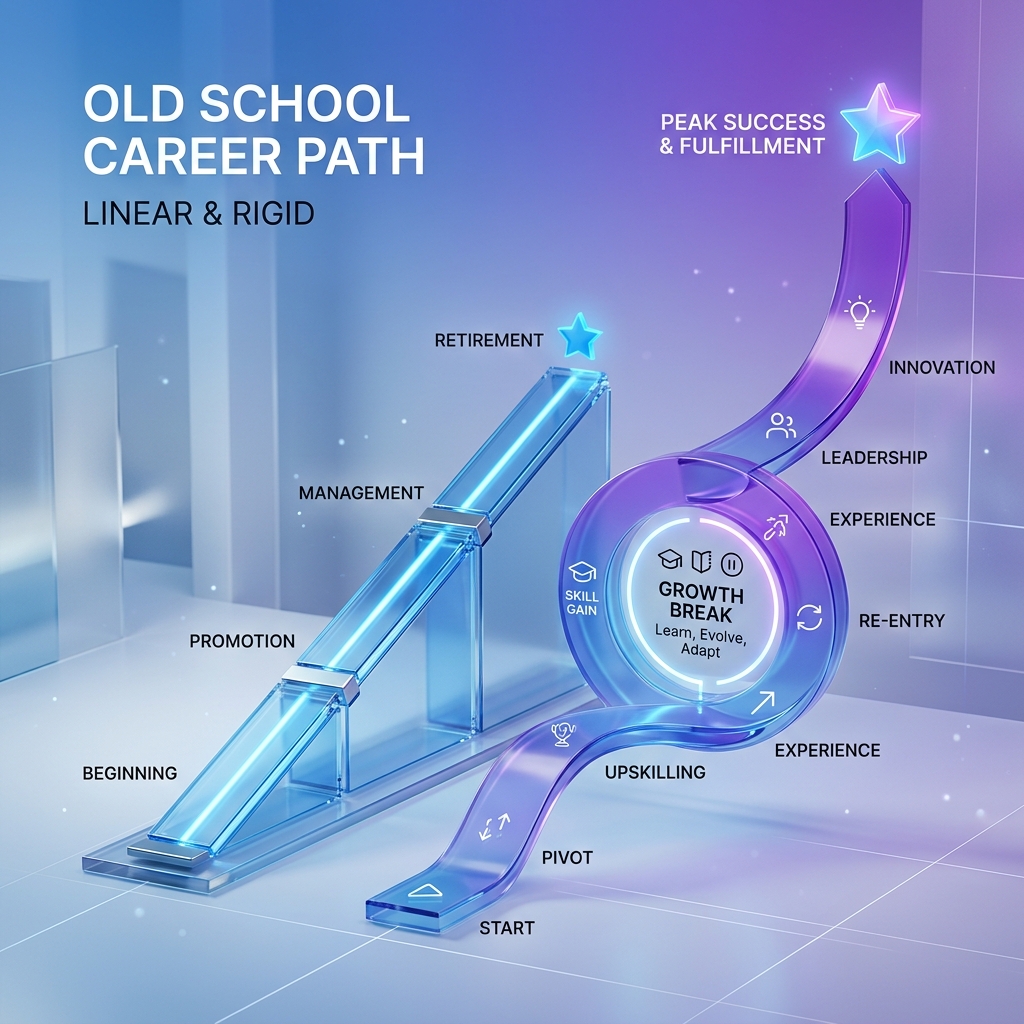
As shown in the graphic above, the Modern Growth Path (the curved one) often ends at a higher trajectory than the Linear Old-School Path. Why? Because the person who takes the "Growth Loop" (the career break) returns with:
- Zero technical debt: They’ve had time to learn the latest tools while others were stuck in legacy workflows.
- High emotional fuel: They aren't running on fumes.
- Strategic clarity: They know exactly what they want from their next role, making them more likely to succeed.
Part 7: Case Study: Sarah’s Comeback (Senior Product Manager)
Sarah was a Senior PM at a top fintech firm. In late 2024, the combination of a major product launch and a toxic management culture led to severe burnout. She quit without a backup plan.
The 18-Month Gap
For the first six months, Sarah did nothing related to work. She focused on health. In the next six months, she did "micro-projects"—helping a local non-profit with their mobile app. In the final six months, she spent two hours a day learning AI-product management.
The Strategy
- Resume: She used our AI Resume Optimizer to scan her draft. It flagged that her description of the non-profit work was "too soft." We helped her rephrase it into: "Managed end-to-end product lifecycle for a non-profit app, resulting in a 20% increase in user engagement."
- LinkedIn: She updated her status to "Strategic Sabbatical" and shared a post about the importance of "Sustainability in Product Leadership." It got 500+ likes and three recruiter DMs.
- The Result: Sarah landed a Lead PM role at a competitor with a 15% salary increase. During the interview, she used the BRIEF method. When the CEO asked about her gap, she framed it as her "Executive Reset." He loved the term so much he asked her to lead a workshop on it for the internal team.
Part 8: Preventing the Next Burnout
Once you land the role, the game changes. You have a responsibility to yourself to ensure you never need a "burnout gap" again.
Modern Career Sustainability Rules:
- The 80% Rule: Never plan for 100% capacity. Leave 20% for the "unexpected."
- Deep Work Blocks: Protect your focus. Constant context switching is a primary driver of burnout.
- The Transparency Habit: If you feel the "red line" approaching, talk to your manager before you reach it. In 2026, good managers will thank you for the heads-up.
Part 9: Detailed FAQ: Your Questions Answered
Q: Should I mention "Mental Health" specifically?
A: You are not legally or professionally obligated to do so. In 2026, "Personal Development" or "Professional Sabbatical" are considered more "business-coded" terms that convey the same result without inviting unwanted bias.
Q: What if they ask for references from the "gap" period?
A: This is rare, but if it happens, provide references from your non-profit work, freelance clients, or even the mentors you met during your upskilling.
Q: Does a gap affect my salary negotiation?
A: Only if you let it. If you frame yourself as "out of practice," they will lowball you. If you frame yourself as "up-to-date and fully refreshed," you maintain your leverage. Authoritative career guides like Forbes confirm that in the 2026 market, your last salary is less important than your current market value.
Q: Can I just lie and say I was "freelancing"?
A: Never. Background checks in 2026 are incredibly thorough. If you say you were freelancing, they may ask for 1099s or client names. Honesty, framed professionally, is 100x safer and more effective.
Final Thoughts: Your Comeback Starts Today
Burnout is a chapter in your book, not the ending. By the time you’ve finished reading this guide, you’ve already taken the most important step: Deciding that your story is worth telling correctly.
The tools for your return are ready. Your skills are waiting. And the 2026 job market is more ready for you than you think.
Ready to see how your new narrative looks on paper? Try our ATS Resume Optimizer Now and let’s turn that gap into your greatest career asset.
Ready to build your perfect CV?
AlignCV helps you create ATS-friendly CVs and tailored cover letters with AI.
Create Your CV NowWritten by
Mehmet Kerem Mutlu
Founder of AlignCV · Mechanical Engineering Student
Mehmet Kerem is a mechanical engineering student and the founder of AlignCV — an AI-powered career platform built to help every job seeker land their next role with confidence. Combining his engineering mindset with a passion for product development, he designs tools that make CV writing, cover letter generation, and interview preparation faster and smarter. He writes about career strategy, AI in hiring, and the future of work.