
The barrier to entry for Junior Full Stack Developers has shifted significantly as we head into 2026. In an era where AI can write boilerplate code in seconds, hiring managers are no longer just looking for someone who knows React or Node.js. They are looking for Systems Thinkers—engineers who understand how the frontend, backend, and infrastructure work together to deliver a high-performance user experience.
If you are a graduate or a self-taught developer looking for your first role, you need to prove that you can bridge the gap between "writing code" and "building products." This means mastering modern frameworks like Next.js 16, understanding serverless architectures, and being able to explain the "why" behind your system design choices.
In this 3,000-word masterclass, we will deconstruct the technical and architectural questions you will face in a 2026 full-stack interview. We will provide you with deep-dive answers and show you how to leverage your technical projects to prove your readiness for a professional engineering team.

The 2026 Tech Stack: Beyond the Basics
In 2026, the concept of "Frontend" and "Backend" is increasingly blurred by technologies that operate at the Edge.
1. Frontend: React Server Components (RSC) and Performance
You aren't just building UIs; you are managing data flow between the server and the client.
- Question: "When should you use a Server Component vs. a Client Component in Next.js?"
- Winning Answer: "I prioritize Server Components for everything that doesn't require immediate user interactivity, such as data fetching or rendering static content. This keeps the client-side bundle small and improves Core Web Vitals. I reserve Client Components for interactive elements like forms, sliders, or real-time updates. By using the "use client" directive strategically, I ensure the fastest possible 'Time to First Byte' (TTFB)."
To ensure your technical skills are presented correctly to modern engineering recruiters, our CV Builder includes templates specifically optimized for full-stack developers that highlight these architectural competencies.
Backend & API Design: Scalability and Real-Time Sync
In 2026, the traditional Express.js server is often replaced or augmented by Serverless Functions and Real-time databases.
- Question: "How do you handle data integrity in a serverless environment with high concurrent traffic?"
- Winning Answer: "I leverage a combination of optimistic UI updates on the frontend and robust database transactions on the backend. If I’m using a tool like PostgreSQL with Supabase, I’ll use Row Level Security (RLS) to ensure data privacy and triggers to maintain consistency. I also focus on 'idempotency' in my API design, ensuring that if a request is retried due to a network glitch, it doesn't create duplicate entries or corrupted states."
For more general advice on engineering interviews, you might find our guide on software engineer interview questions and winning answers helpful.
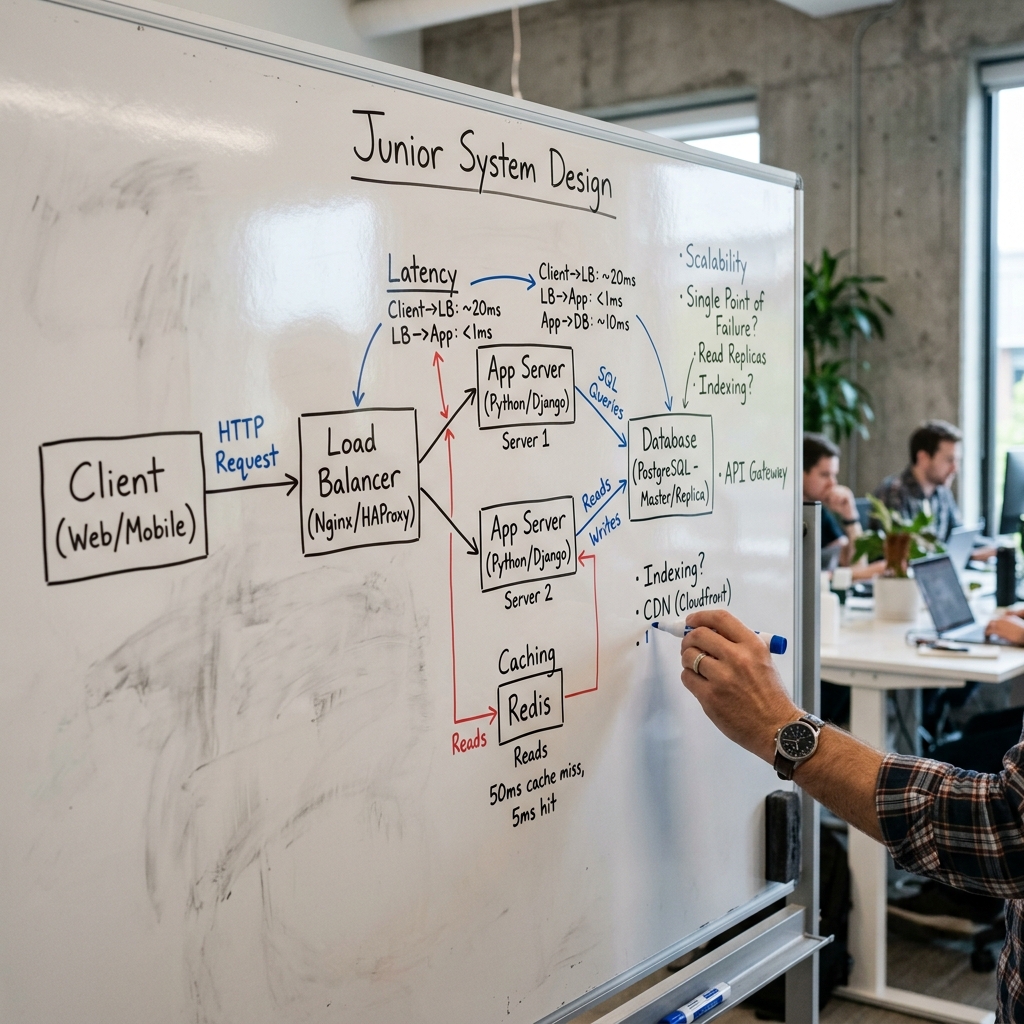
Junior System Design: Thinking Like an Architect
For a junior role, you won't be asked to design the next Netflix, but you will be asked to design a URL Shortener or a Simple News Feed.
- The Challenge: "Design a simple notification system for an app with 10,000 active users."
- The Approach:
- Clarify: "Is this for push notifications, email, or in-app?"
- The Flow: Client -> API Gateway -> Message Queue (e.g., RabbitMQ or Redis) -> Worker Service -> Third-party Provider (e.g., Twilio).
- Trade-offs: "I’d use a message queue here to ensure that the API stays responsive during high-traffic bursts. If the notification service is down, the messages stay in the queue until it’s back up."
[!TIP] Always mention Caching. In 2026, understanding how to use Redis or even simple browser caching to reduce database load is a sign of a mature developer.
Surviving the AI-Assisted Interview
In 2026, many companies allow you to use AI tools like GitHub Copilot during the interview—but there's a catch. They aren't testing if you can generate code; they are testing if you can Debug and Optimize it.
If you aren't sure if your project descriptions and technical stack are clear to both AI and human recruiters, you should start with an Initial Assessment. Our Free ATS Checker can scan your resume and tell you if your 'Full Stack' keywords are performing well or if your technical section is too generic.
If your score is lower than expected, you can use our ATS Optimizer to fine-tune your technical bullet points, ensuring you use the right verbs and quantify your impact (e.g., "Reduced bundle size by 30% using tree-shaking").
The 2026 Behavioral "Engineering" Questions
Beyond the code, how do you work in a team?
- Question: "Tell me about a time you had a technical disagreement with a teammate."
- The Pro Tip: Don't talk about who was "right." Talk about how you used Data or Documentation to resolve the issue. "We were debating between GraphQL and REST. I built a quick proof-of-concept for both and measured the latency. The data showed that GraphQL was better for our nested data requirements, so we moved forward with that."
If you want to practice these high-stakes behavioral scenarios, our AI Interview Coach can simulate a technical lead or a senior engineer challenging your decisions in real-time.

Final Checklist for Junior Full Stack Success
- Master the Fundamentals: Know your Data Structures (Arrays, Maps, Sets) and how they affect time complexity.
- Understand the 'Full' in Full Stack: Be prepared to discuss deployment (CI/CD) and monitoring.
- Clean Code is King: Ensure your GitHub projects have a clear README.md and readable commit history.
- Know Your Tools: Be ready to explain why you chose your specific stack (e.g., PostgreSQL vs. MongoDB).
For those who are just starting their professional journey, our guide on CV tips for fresh graduates with no experience offers essential advice on how to make your educational projects look like professional achievements.
Build Your Engineering Future
In 2026, the transition from "Junior" to "Mid-level" happens faster for those who understand the architecture. By aligning your application with these modern technical standards and using the tools at your disposal, you can ensure you are the one signing the offer letter.
Practice with our AI Mock Interviewer
Simulate real interviews, get instant feedback, and build confidence before the big day.
Start PracticingWritten by
Mehmet Kerem Mutlu
Founder of AlignCV · Mechanical Engineering Student
Mehmet Kerem is a mechanical engineering student and the founder of AlignCV — an AI-powered career platform built to help every job seeker land their next role with confidence. Combining his engineering mindset with a passion for product development, he designs tools that make CV writing, cover letter generation, and interview preparation faster and smarter. He writes about career strategy, AI in hiring, and the future of work.