
Applying for jobs in multicultural regions, border-crossing markets, or multinational corporations often requires demonstrating fluency in multiple languages. However, many bilingual candidates make critical formatting mistakes when presenting their qualifications.
The most common error is attempting to combine two languages on a single document (such as listing bullet points in both English and German, or using dual-language headings). This results in a cluttered, confusing layout that is rejected by Applicant Tracking Systems (ATS) and human recruiters alike.
If you are targeting multiple countries, you can use our CV Builder to create and manage separate, perfectly formatted resumes for each target market. Before submitting your applications, upload your documents to our ATS Optimizer to scan for keyword compliance in each language.
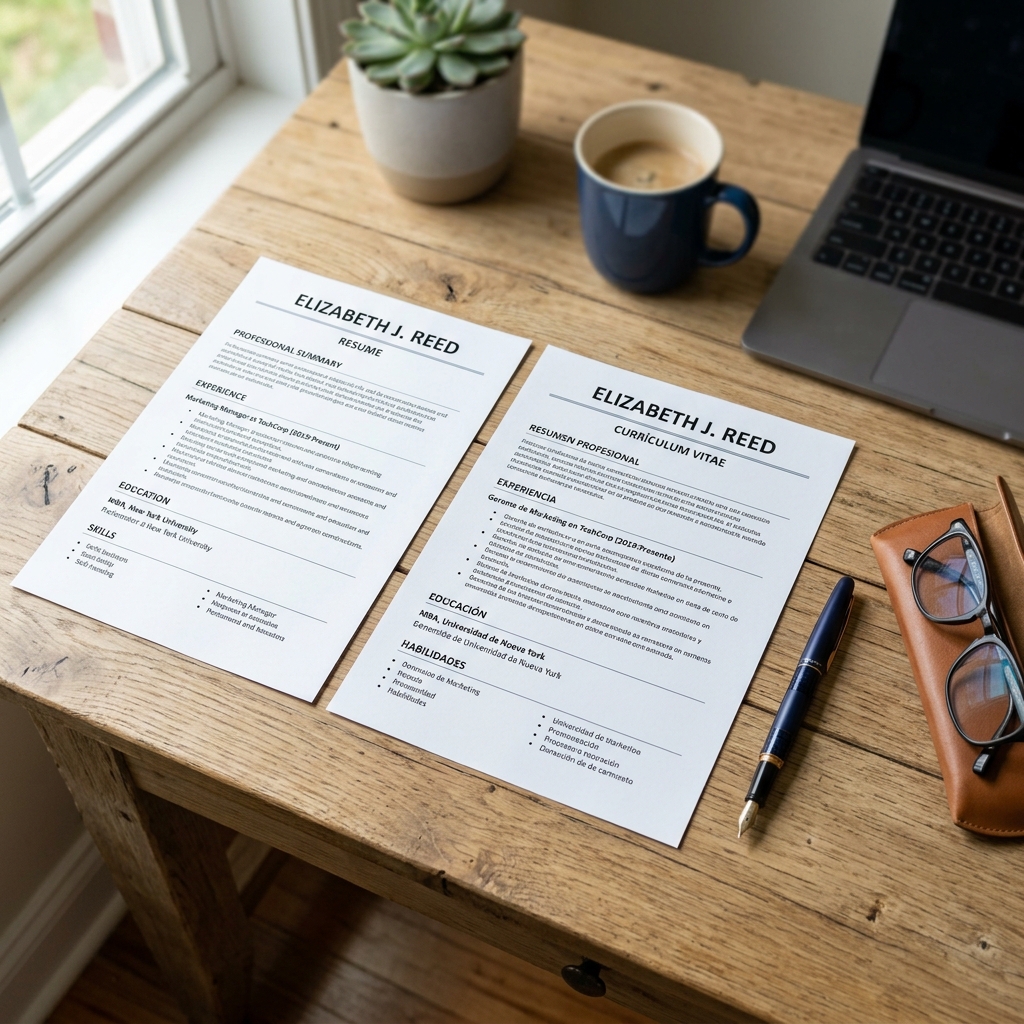
The Golden Rule: Create Two Separate Documents
[!IMPORTANT] Never write a dual-language resume. A professional resume should be written entirely in a single language.
If a job posting is in English, submit an English resume. If it is in French, submit a French resume. If the employer asks for a bilingual application, submit two separate files (e.g. Jane_Doe_Resume_English.pdf and Jane_Doe_CV_French.pdf) that feature identical professional histories but are fully localized for each target market.
4 Rules to Maintain Symmetrical Bilingual Resumes
1. Maintain Identical Layouts and Chronology
Your English and international resumes must mirror each other structurally. If a recruiter compares the two documents, the job titles, employment dates, company names, and bullet point counts should align perfectly. This establishes professional consistency.
- Use the same font, font sizes, margins, and header styles on both documents.
- Ensure the chronological order of your experiences is identical.
2. Avoid Literal Translations (Use Market Equivalents)
Translating job titles or responsibilities literally often leads to terms that make no sense to foreign recruiters. Research the industry-standard job titles and professional verbs in your target market.
- Literal Translation (Poor): Responsible for the control of the box of the store.
- Professional Equivalent (English): Managed daily cash register reconciliations and store inventory controls.
- Literal translation of degree: Licentiate in Business.
- Professional equivalent: Equivalent to a UK/US Bachelor's Degree in Business Administration.
3. Adjust for Regional Compliance Rules
While the content of your resumes should match, you must customize certain elements to meet the compliance regulations of each country:
| Formatting Element | European CV (e.g., France/Germany) | US/UK Resume Format |
|---|---|---|
| Profile Photo | Expected / Common. | Strictly forbidden (To prevent discrimination). |
| Personal Details | Nationality, DOB, and driving license often included. | Omitted entirely (Only name and contact details). |
| Document Length | Often 2 to 3 pages. | Strictly capped at 1 or 2 pages. |
| Language Profile | Detailed CEFR levels (e.g., English C1). | General proficiency levels (e.g., English - Fluent). |
If you are planning to convert a European document to a UK/US format, read our detailed guide on how to convert a Europass CV to a UK/US resume to ensure full compliance.
4. Frame Bilingualism as an Asset, Not Just a Skill
In your professional summary, describe how your language skills drive business value.
- Example: "Bilingual Project Manager with 5+ years of experience leading cross-functional teams in English and Spanish, streamlining communication and reducing project delays by 18%."
Frequently Asked Questions
Which language should I use if a job posting is written in two languages?
If a job description is written in multiple languages, look at the primary language used for the instructions or look up the headquarters of the company. If it is a US-based firm recruiting in Germany, submit your English resume as the primary document, but attach your German resume as a secondary file to prove local integration.
How do I list my language proficiency levels?
Use terms that represent your workplace capabilities.
- Native / Bilingual: You grew up speaking both languages fluently.
- Full Professional Proficiency: You can lead meetings, negotiate contracts, and write complex reports without assistance.
- Professional Working Proficiency: You can participate in standard workplace conversations and write emails, but may require minor review for complex documents.
- Conversational: You can handle everyday conversations, but are not ready to work entirely in this language.
Do I need to translate company names?
No. Never translate official company names. If you worked at "Banco do Brasil," keep it as "Banco do Brasil" on both resumes. However, you can add a brief parenthetical description to give context to foreign recruiters (e.g., Banco do Brasil (Brazil's largest financial institution)).
Bilingual Resume Success Checklist
Review both of your resumes against this quality check before applying:
- Two Separate Files Created: You have two distinct documents, each written entirely in a single language.
- Identical Chronology Verified: The dates, titles, and section structures match on both files.
- Regional Compliance Applied: Photos and birthdates are removed from the UK/US version.
- No Double Quotes inside Blockquotes: Check that any quotes or blockquote examples are free of manual double quotes.
- Three Short Tags: The post's frontmatter contains exactly three short tags.
- Relative Internal Links: Verify links point correctly to the builder, optimizer, and interview coach.
Ready to build your perfect CV?
AlignCV helps you create ATS-friendly CVs and tailored cover letters with AI.
Create Your CV NowWritten by
Mehmet Kerem Mutlu
Founder of AlignCV · Mechanical Engineering Student
Mehmet Kerem is a mechanical engineering student and the founder of AlignCV — an AI-powered career platform built to help every job seeker land their next role with confidence. Combining his engineering mindset with a passion for product development, he designs tools that make CV writing, cover letter generation, and interview preparation faster and smarter. He writes about career strategy, AI in hiring, and the future of work.