

The cybersecurity industry is famously paradoxical: there is a massive global talent shortage, yet entry-level candidates struggle to land their first job. If you are applying for an Entry-Level Security Operations Center (SOC) Analyst role in 2026, you are likely competing against hundreds of applicants who possess the exact same baseline credential: the CompTIA Security+ certification.
To stand out to a Chief Information Security Officer (CISO) or a Lead SOC Manager today, your resume must transcend multiple-choice exams. The modern SOC is a high-speed, AI-augmented environment heavily reliant on Security Orchestration, Automation, and Response (SOAR) pipelines and cloud-native architectures.
In this comprehensive 3,000-word guide, we will deconstruct the 2026 SOC Analyst resume. We will show you exactly how to translate your self-study, your "Homelab" projects, and your foundational knowledge into an ATS-friendly format that screams "Deployable Asset."

Part 1: The Anatomy of a 2026 SOC Analyst
Before you write a single bullet point, you must understand what the hiring manager is actually looking for. The days of hiring someone just to stare at a SIEM (Security Information and Event Management) dashboard and manually triage alerts are fading. AI agents now filter the "noise."
The "T-Shaped" Cyber Professional
In 2026, recruiters want a "T-shaped" analyst. This means you have broad foundational knowledge across networking, operating systems, and compliance, but you have dug deep into one specific area—such as Malware Analysis, Cloud Security (AWS/Azure), or Threat Intelligence.
The Three Pillars of a SOC Resume
- Practical Tooling over Theory: Knowing what an IDS (Intrusion Detection System) is matters less than having configured Snort or Suricata on a virtual machine.
- Automation Readiness: Python and Bash scripting are no longer optional. You must show how you automate repetitive triage tasks.
- Framework Fluency: You must speak the language of the NIST Cybersecurity Framework and the MITRE ATT&CK matrix.
Part 2: The Professional Summary — The 'Alert Triage'
Your Professional Summary is the first "alert" the recruiter sees. If it is a false positive (full of buzzwords but no substance), you will be ignored. Keep it to 3-4 lines, highlighting your core competency, your homelab experience, and your target trajectory.
The Problem with Most Summaries
Most entry-level summaries read like this: "Passionate cybersecurity graduate with Security+ looking to protect networks from hackers." This is generic and provides zero technical context.
The 2026 Standard Summary
Highly analytical Tier 1 SOC Analyst candidate with active CompTIA Security+ and CySA+ certifications. Dedicated 300+ hours to building a localized Active Directory Homelab to simulate lateral movement and deploy Splunk SIEM for log analysis. Proficient in Python scripting for API-driven threat intelligence gathering. Eager to bring aggressive continuous monitoring and incident response capabilities to a forward-thinking Blue Team.
Part 3: The Secret Weapon — The 'Homelab & Projects' Section
If you do not have commercial cybersecurity experience, your Projects / Homelab section is the most important part of your resume. This proves you have "hands-on keyboard" experience.
How to Format a Homelab Project
Treat your Homelab like a job. Use the STAR-Impact Method (Situation, Task, Action, Result, Impact) to describe what you built.
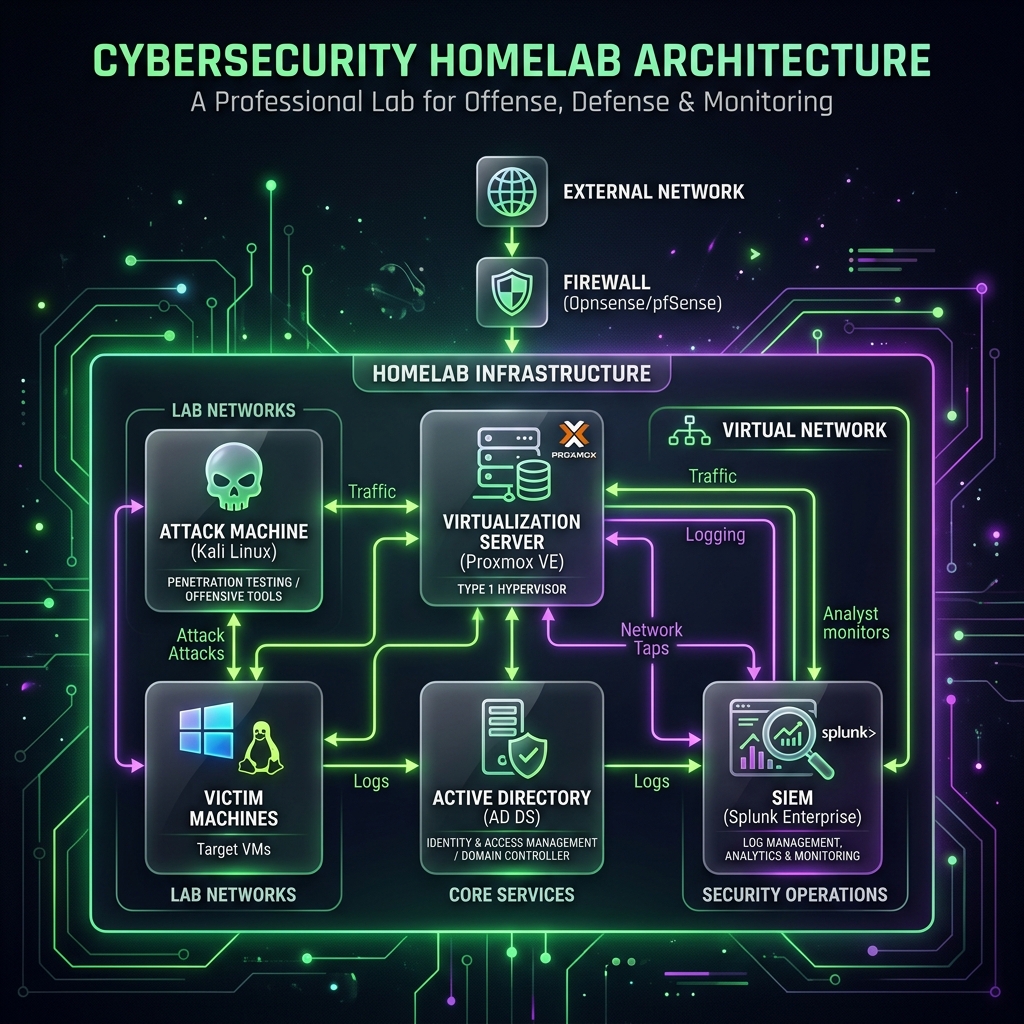
Project: Enterprise SIEM Deployment & Attack Simulation
- Action: Provisioned a virtualized Windows Server 2022 / Active Directory environment using Proxmox to serve as a target infrastructure.
- Action: Deployed and configured Splunk Enterprise to ingest Windows Event Logs and Sysmon data, establishing baseline network behavior.
- Action: Executed simulated credential dumping (Mimikatz) and pass-the-hash attacks using Kali Linux to generate malicious telemetry.
- Result: Authored custom SPL (Search Processing Language) queries to successfully detect the anomalous activity, reducing the theoretical time-to-detect (TTD) from days to minutes.
This single project bullet proves you understand networking, virtualization, offensive tooling, and defensive log analysis.
Part 4: Technical Skills — Beating the ATS
Large organizations use Applicant Tracking Systems (ATS) to filter resumes based on keyword density. However, Buzzword Stuffing will get you rejected in the interview phase if you cannot back it up.
Organize your skills logically so both the machine and the human can parse them easily.
1. SIEM & Log Analysis
Do not just list "SIEM." Be specific: Splunk, Microsoft Sentinel, IBM QRadar, ELK Stack (Elasticsearch, Logstash, Kibana).
2. Networking & Infrastructure
Wireshark (PCAP analysis), TCP/IP protocols, Cisco Packet Tracer, pfSense firewalls, and subnetting.
3. Incident Response & Frameworks
SANS Incident Response Process (Preparation, Identification, Containment, Eradication, Recovery, Lessons Learned), MITRE ATT&CK, NIST 800-53, Cyber Kill Chain.
4. Scripting & Automation
Python (Requests library, Pandas for log parsing), PowerShell (Active Directory administration), Bash.
Pro-Tip: Use our ATS CV Builder to ensure your technical skills section is perfectly formatted for cybersecurity recruitment algorithms.
Part 5: Redefining Non-IT Experience
Many candidates hide their previous non-IT jobs (like retail or hospitality). This is a mistake. Working in a SOC is incredibly stressful and requires elite communication skills.
The 'Burnout' Factor
A major issue in modern SOCs is "Alert Fatigue"—analysts burning out from endless notifications. (If you are transitioning careers due to stress, read our guide on Explaining Career Gaps Due to Burnout).
If you worked as a 911 Dispatcher, a Retail Manager, or an ER Nurse, you have proven experience in High-Stress Triage.
Translating Retail to Cyber:
- Before: Handled angry customers at the return desk.
- After (Cyber Translation): Demonstrated high emotional intelligence and de-escalation skills during high-pressure situations, analogous to managing cross-departmental panic during a critical security incident.
Part 6: Preparing for the Technical Interview
Once your resume secures the interview, you must be ready to defend it. SOC interviews in 2026 are heavily scenario-based.
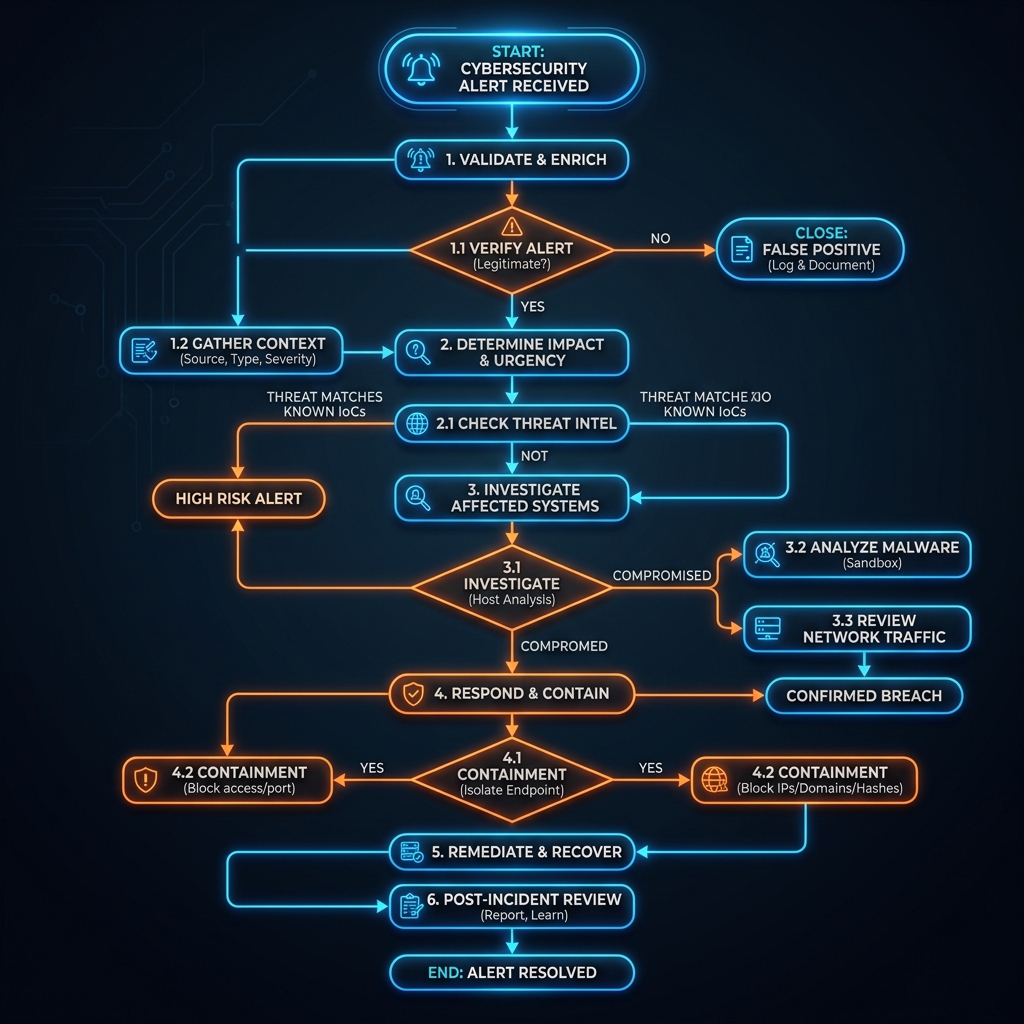
Scenario: "You see an alert for an impossible travel login (e.g., a user logged in from New York, and 10 minutes later from Moscow). Walk me through your triage process."
The Framework Answer:
- Verify the Alert: "First, I validate the IP addresses using threat intelligence platforms like VirusTotal or GreyNoise to rule out known VPN or proxy nodes."
- Contextualize: "I check the user's typical baseline behavior. Is this the CEO who is traveling, or a local intern?"
- Investigate the Endpoint: "If the login was successful, I check what resources were accessed immediately after the Moscow login. Did they attempt to download the active directory database or access sensitive SharePoint files?"
- Containment: "If the behavior is malicious, I follow the playbook to force a password reset, revoke active session tokens, and isolate the potentially compromised endpoint."
Part 7: Final Optimization Checklist
Before you submit your application, run through this final checklist:
- Are your certifications listed at the top? (Security+, CySA+, BTL1, PJPT).
- Did you link to your GitHub or Medium? A blog documenting your homelab setups or Capture The Flag (CTF) write-ups is invaluable.
- Is it maximum one or two pages? Keep it concise.
- Did you use an ATS-friendly format?
Accelerate Your Cyber Career with AlignCV
Building the perfect cybersecurity resume requires precision.
- Practice defending your Homelab architecture with our AI Interview Coach.
- Generate a flawlessly formatted, ATS-compliant document using our CV Builder.
Final Thoughts: The Mindset of a Defender
Writing a resume for a SOC Analyst position is your first test in threat modeling. The "Threat" is being filtered out by the ATS; the "Vulnerability" is a lack of practical experience; the "Mitigation" is building a Homelab and documenting your continuous learning.
In 2026, companies aren't just hiring people who know how to pass a certification exam. They are hiring digital defenders who are curious, resilient, and passionate about solving complex puzzles under pressure. Show them you have the hands-on skills, the analytical mindset, and the drive to protect their perimeter.
Your watch begins now.
Ready to build your perfect CV?
AlignCV helps you create ATS-friendly CVs and tailored cover letters with AI.
Create Your CV NowWritten by
Mehmet Kerem Mutlu
Founder of AlignCV · Mechanical Engineering Student
Mehmet Kerem is a mechanical engineering student and the founder of AlignCV — an AI-powered career platform built to help every job seeker land their next role with confidence. Combining his engineering mindset with a passion for product development, he designs tools that make CV writing, cover letter generation, and interview preparation faster and smarter. He writes about career strategy, AI in hiring, and the future of work.