

The oil and gas graduate recruitment landscape in 2026 is highly competitive. Major energy primes like BP, Shell, Chevron, ExxonMobil, and Equinor are seeking the next generation of engineering talent to navigate a complex energy mix. Today’s graduate engineers are expected to optimize traditional oilfield extraction, manage digital refinery twins, and pioneer carbon capture and storage (CCS) technologies. Consequently, the graduate interview process is rigorous, consisting of initial automated screenings, intensive technical panels, and assessment center days.
To secure a graduate job offer, you must demonstrate a deep understanding of core engineering principles, a non-negotiable commitment to safety, and the ability to articulate your experiences using the STAR method (Situation, Task, Action, Result).
As you prepare for these high-stakes interviews, review your academic portfolio. You can use our premium CV Builder to ensure your engineering projects and technical skills are presented clearly. Additionally, it is highly recommended to perform an initial assessment of your application document. Upload your resume to our Free ATS Checker to run a quick scan for essential keywords like fluid dynamics, thermodynamics, and heat transfer to ensure your profile is fully optimized.

The Structure of a Graduate Energy Interview
Oil and gas graduate interviews generally focus on three distinct areas:
- Technical Competence: Panelists will test your fundamental engineering knowledge. For petroleum engineers, this includes reservoir properties and recovery methods. For process or chemical engineers, this involves thermodynamics, heat transfer, and distillation physics.
- Safety and Risk Awareness: Safety is the foundation of the energy sector. You will face situational questions testing your ethical boundaries, understanding of hazard identification (HAZOP/HAZID), and personal accountability in high-risk zones.
- Behavioral Competency: These questions evaluate your leadership, teamwork, adaptability, and problem-solving skills. The panel want to know how you work within multidisciplinary teams and resolve technical disagreements.
Deconstructing Technical Core Concepts
To prepare for technical questions, you should review these fundamental topics:
The Industry Value Chain
- Upstream: Exploration and Production (E&P). Involves locating underground crude oil and natural gas reservoirs, drilling wells, and extracting the resource to the surface.
- Midstream: Transportation and Storage. Involves moving resources via pipelines, tankers, or barges to processing facilities, and managing bulk storage terminals.
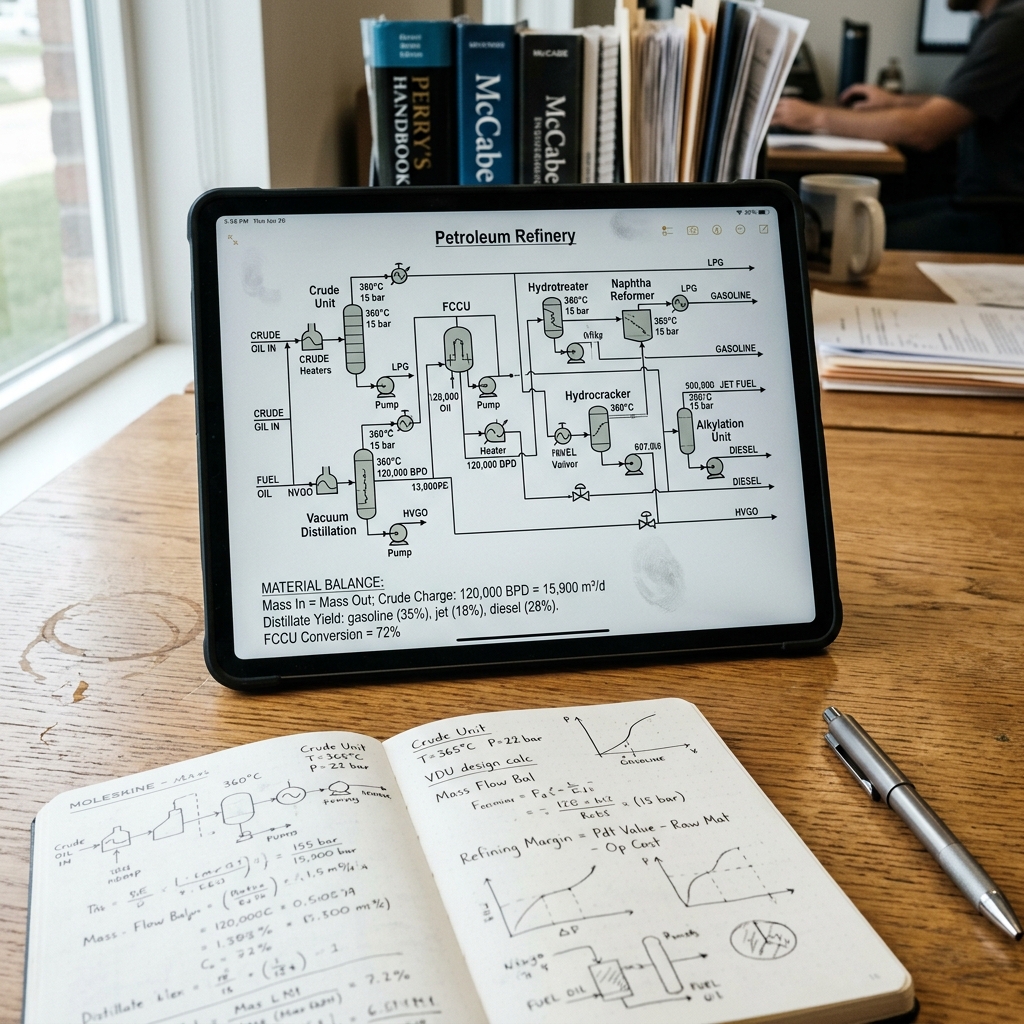
- Downstream: Refining and Marketing. Involves refining crude oil into finished products (gasoline, diesel, jet fuel, petrochemicals) and distributing them to commercial markets.
Reservoir and Fluid Basics
- Porosity ($\phi$): The measure of the void space in a rock, representing its storage capacity for fluids.
- Permeability ($k$): The measure of a rock’s ability to transmit fluids through its interconnected pore network.
- Recovery Mechanisms: Primary recovery (natural reservoir pressure), secondary recovery (water or gas injection to maintain pressure), and tertiary/Enhanced Oil Recovery (EOR - chemical, thermal, or miscible gas injection).
Process Operations
- Heat Transfer: Conduction, convection, and radiation. Understanding shell-and-tube heat exchanger design, fouling factors, and temperature profiles is critical for process engineering candidates.
- Mass Transfer & Separation: Distillation columns, fractionating trays, reflux ratios, and vapor-liquid equilibrium (VLE).
If you want to practice delivering these technical explanations under simulated interview conditions, you can practice with our interactive AI Interview Coach to build your confidence and refine your structure.
Top 6 Technical & Competency-Based Questions and Scripted Answers
Question 1: "Explain the difference between porosity and permeability, and why both are critical for reservoir evaluation."
What they are looking for: Academic accuracy, clear communication of physics, and the ability to explain how these properties interact to determine the commercial viability of a reservoir.
Situation: When evaluating a potential hydrocarbon reservoir, engineers must assess both storage capacity and fluid flow potential.
Task: The task is to define porosity and permeability clearly, explain their physical difference, and show how a rock can possess one but not the other.
Action: I define porosity as the percentage of bulk volume of rock occupied by void space. It is calculated as pore volume divided by total bulk volume. Porosity dictates the total volume of hydrocarbons present in the reservoir. Permeability, on the other hand, is the measure of the rock’s ability to transmit fluids through its pore spaces, governed by Darcy's Law. It is dependent on the size and interconnectivity of those pores.
To illustrate their difference, I consider a pumice stone or a shale formation. Pumice has exceptionally high porosity due to gas bubbles, but because the pores are isolated and not interconnected, it has zero permeability and cannot transmit fluid. Conversely, a fractured sandstone may have moderate porosity but very high permeability because the fractures create direct, interconnected pathways for fluid flow.
Result: In reservoir evaluation, both metrics are critical. High porosity tells us there is a large volume of oil in place, but if permeability is low, we cannot extract it at a commercial rate without hydraulic fracturing or stimulation, which directly impacts the project's financial viability.
Question 2: "Describe a time when you had to make a technical decision with incomplete or conflicting data."
What they are looking for: Analytical thinking, risk management, and the ability to make logical engineering assumptions based on data.
Situation: During my senior design project, our team had to size a pipeline for transporting crude oil from a simulated offshore field, but the fluid analysis report contained conflicting viscosity data at low temperatures.
Task: I needed to select the correct design viscosity to size the pipeline diameter and select pump specifications, preventing pipeline clogging without over-engineering the system and inflating costs.
Action: I first gathered all data points and identified that the discrepancy occurred at the wax appearance temperature (WAT). I did not make a guess; instead, I conducted a sensitivity analysis. I modeled the pipeline flow profile in MATLAB using both the highest and lowest viscosity values. I researched external peer-reviewed papers from the Society of Petroleum Engineers (SPE) to find typical fluid profiles for that geographical region. Based on my research, I made a structured engineering assumption that the higher viscosity values represented the worst-case operating scenario during winter. I designed the pipeline diameter using the worst-case scenario but proposed installing a localized electrical trace heating element to mitigate wax deposition rather than sizing a larger, expensive pump.
Result: The final pipeline design was approved by our academic advisor. The sensitivity model proved that our trace heating solution reduced the required pumping power by 30%, saving £150,000 in simulated capital expenditure while guaranteeing safe operations.
Question 3: "If you observed a senior engineer bypassing a standard safety protocol to meet a production deadline, what actions would you take?"
What they are looking for: Commitment to safety, courage, professional communication, and understanding of safety reporting structures.
Situation: Safety is the absolute priority in energy operations. Bypassing a safety protocol, even by a senior colleague, is a critical hazard that can lead to catastrophic failure.
Task: I would need to intervene immediately to ensure site safety, maintaining a professional but firm stance, and follow the trust's reporting protocol.
Action: I would act immediately. I would not stay silent due to our difference in seniority. I would approach the engineer politely and ask a clarifying question to highlight the bypass, such as: "Excuse me, I noticed the Lockout/Tagout padlocks aren't on this valve yet. Are we waiting for the clearance permit before opening it?" If they brushed it off to meet the deadline, I would confidently state that I cannot permit work to continue without the protocol being followed, referencing our shared Stop Work Authority. If the engineer refused to halt the action, I would immediately escalate the issue to the Shift Supervisor and the on-site Safety Officer, documenting the event.
Result: By utilizing my Stop Work Authority, I would ensure that the unsafe action is halted before an incident occurred. Although it might create temporary friction, prioritizing safety is non-negotiable and aligns directly with the core values of any professional energy operator.
Question 4: "What is your understanding of the difference between Upstream, Midstream, and Downstream operations?"
What they are looking for: General industry literacy, understanding of how the supply chain fits together, and commercial awareness.
Situation: To work effectively within a global energy company, graduates must understand the entire value chain of the oil and gas industry.
Task: The task is to define the three main sectors of the industry and explain how they connect to deliver energy products to market.
Action: I structure the value chain chronologically. Upstream is the exploration and production (E&P) sector. It involves geological surveys, drilling exploratory wells, and operating production wells to extract crude oil and natural gas.
Midstream is the logistics and transportation sector. It bridges upstream and downstream by moving the raw hydrocarbons over long distances via pipeline networks, rail cars, and marine tankers. It also includes bulk storage facilities and crude terminal management.
Downstream is the refining and processing sector. It takes the raw crude oil and gas and refines them into final consumer products, such as gasoline, diesel, jet fuel, heating oil, and petrochemical feedstocks for manufacturing. It also handles the distribution and retail sales of these products.
Result: Understanding this flow is essential because a change in one sector directly impacts the others. For example, a production surge in upstream requires midstream capacity adjustments to prevent bottlenecking at downstream refineries.
Question 5: "Explain the operation of a shell-and-tube heat exchanger and how you would troubleshoot a sudden drop in heat transfer efficiency."
What they are looking for: Thermodynamic principles, understanding of process hardware, and logical troubleshooting methodology.
Situation: In a petrochemical refinery, a critical shell-and-tube heat exchanger used to pre-heat crude oil before the distillation column experienced a sudden 15% drop in heat transfer efficiency.
Task: I needed to systematically identify the root cause of the efficiency drop and propose corrective actions.
Action: I began by reviewing the operating parameters on our control system, checking the inlet and outlet temperatures, pressures, and flow rates for both the tube-side (crude oil) and shell-side (hot utility fluid). I calculated the Log Mean Temperature Difference (LMTD) and compared it to historical baseline data.
To troubleshoot the drop, I looked for two primary causes: fouling or a bypass leak. A sudden pressure drop on the tube side would indicate blockages or fouling, while a drop in shell-side pressure could indicate a damaged baffle or tube leak. I checked the pressure transmitters and noted a significant pressure drop across the tube bundle. I concluded that tube-side fouling was occurring due to organic deposits. I recommended isolating the exchanger, executing a chemical cleaning cycle, and checking the feed filters.
Result: The chemical clean restored the heat transfer coefficient to within 2% of the design baseline, reducing fuel consumption in the pre-heat furnace and maintaining column throughput.
Question 6: "Tell me about a time you led a team of engineering students to solve a complex project bottleneck."
What they are looking for: Leadership, delegation, task allocation, conflict resolution, and delivering results under pressure.
Situation: During a university design project to model an off-grid gas processing plant, our team fell three weeks behind schedule because we struggled to resolve mass balance discrepancies in our simulation software.
Task: As team leader, I needed to restructure our workflow, resolve the simulation errors, and deliver the final report before the academic deadline.
Action: I called an emergency meeting and conducted a task audit. I discovered that two team members were working on the same simulation file, causing conflicts, while another member felt overwhelmed by the thermodynamic equations. I restructured the team into sub-groups. I assigned our strongest programmer to focus purely on debugging the software script, paired the struggling member with a peer to run the math validations manually, and took ownership of writing the final documentation. I set up daily 10-minute check-ins to monitor progress and address problems immediately.
Result: By delegating tasks based on individual strengths and establishing clear communication channels, we resolved the simulation errors within four days. We completed the model and submitted the 80-page design report two days before the deadline, securing a first-class grade.
Technical Problem-Solving: The "Think Aloud" Strategy
If an interviewer asks you a complex technical question and you do not know the answer, do not panic or guess. The panel is often more interested in your problem-solving methodology than a memorized textbook formula.
- Acknowledge and Pivot: Say: "I haven't encountered this specific scenario before, but based on my understanding of fluid dynamics, here is how I would approach it..."
- State Your Assumptions: Clearly explain the boundaries of the problem. For example: "I am going to assume a steady-state flow, an incompressible Newtonian fluid, and negligible friction losses in the system."
- Think Aloud: Speak your thought process. Explain the physics equations you would use (e.g., Bernoulli's equation, mass balance) and how you would isolate variables.
- Reference Reliable Sources: Explain how you would verify your work: "If I were on the job, I would consult the API (American Petroleum Institute) standards, review the plant's operating manuals, or consult a senior process specialist to verify my calculations."
Frequently Asked Questions
What is the difference between competency-based and technical questions?
Competency-based questions evaluate your behavior and soft skills by asking for real-world examples of how you handled challenges (e.g., teamwork, conflict, prioritization). They are answered using the STAR method. Technical questions test your academic engineering knowledge, problem-solving skills, and understanding of physical systems, software (e.g., HYSYS, MATLAB), and mathematical principles.
How heavily is carbon capture and storage (CCS) featured in graduate interviews?
In 2026, sustainability and energy transition are critical topics for all major energy firms. You should expect at least one question on how traditional engineering skills (such as reservoir modeling or process separation) apply to CCS, hydrogen transport, or emissions reduction. Researching the company’s specific net-zero goals before the interview is highly recommended.
Do I need to memorize specific refining or drilling equations for the interview?
You do not need to memorize complex, multi-variable formulas, but you must understand core thermodynamic and fluid mechanics equations (e.g., Darcy's Law, Bernoulli's equation, heat transfer rate equation $Q = U A \Delta T_{lm}$, and the ideal gas law). Knowing how to apply these concepts to troubleshoot physical systems is far more important than memorizing coefficients.
What questions should I ask the interview panel at the end of my session?
Ask mature, process-oriented questions that demonstrate you are thinking like a professional engineer. For example:
- "How does the team share lessons learned after a near-miss or safety incident on site?"
- "What are the biggest operational bottlenecks the refinery team is currently addressing?"
- "How are digital twin simulations being integrated into your preventative maintenance workflows?"
How should I prepare for a virtual technical interview?
Ensure you have a reliable internet connection, a quiet environment, and a clean workspace. Keep a notepad, pen, and calculator nearby. If asked to solve a problem, you can sketch diagrams or write out equations on paper and hold them up to the camera to explain your thought process clearly to the panel.
How does the assessment center stage compare to the technical interview?
The technical interview is a structured panel focused on your personal engineering skills and academic background. The assessment center is a multi-hour or full-day event involving group exercises, case studies, and presentations. It evaluates how you collaborate, communicate, and lead within a team when solving simulated business and engineering scenarios under pressure.
The Graduate Interview Preparation Checklist
Before you sit down for your graduate interview, ensure you have completed these steps:
- Reviewed the Value Chain: You can define Upstream, Midstream, and Downstream operations and give examples of each.
- Structured 5 STAR Stories: Prepared examples covering team leadership, technical uncertainty, safety compliance, and resolving conflict.
- Checked Company Values: Read the specific mission statement of the company you are interviewing with and prepared to link it to your answers.
- Strictly 3 Short Tags: The frontmatter has exactly three short tags to prevent blog card UI wrapping.
- No Manual Quotes in Blockquotes: Verified that all technical and behavioral examples inside blockquotes do not contain manual double quotes.
- Woven Internal Links: Natural links to our CV builder, optimizer, and interview coach are integrated within sentences.
Preparing systematically for technical and competency-based questions is the key to passing graduate screenings in the energy sector. By demonstrating technical competence, a safety-first mindset, and structured communication, you will stand out as an exceptional candidate ready to contribute to global energy solutions.
Practice with our AI Mock Interviewer
Simulate real interviews, get instant feedback, and build confidence before the big day.
Start PracticingWritten by
Mehmet Kerem Mutlu
Founder of AlignCV · Mechanical Engineering Student
Mehmet Kerem is a mechanical engineering student and the founder of AlignCV — an AI-powered career platform built to help every job seeker land their next role with confidence. Combining his engineering mindset with a passion for product development, he designs tools that make CV writing, cover letter generation, and interview preparation faster and smarter. He writes about career strategy, AI in hiring, and the future of work.