

Securing an interview for an administrative role in the National Health Service (NHS) is a major milestone. NHS clerical and administrative positions—ranging from Ward Clerks and Medical Secretaries to Clinic Coordinators and Departmental Administrators—are highly competitive. However, the NHS interview process can feel daunting if you are unfamiliar with its structured format. Unlike private-sector interviews which can be conversational, NHS interviews are competency-based and scoring-panel driven.
To succeed, you must structure your responses using the STAR method (Situation, Task, Action, Result) and align your examples with the core values of the NHS Constitution. In this guide, we will break down the mechanics of the NHS administrative interview, explain how to build high-scoring STAR responses, and provide fully scripted answers to the most common questions you will face.
As you prepare your application and review your career history, ensure your foundation is solid. You can draft an optimized CV using our CV Builder to ensure all key terms match the person specification. Additionally, run an initial assessment of your document by uploading it to our Free ATS Checker to perform a quick scan and identify any structural gaps before your interview panel reviews it.
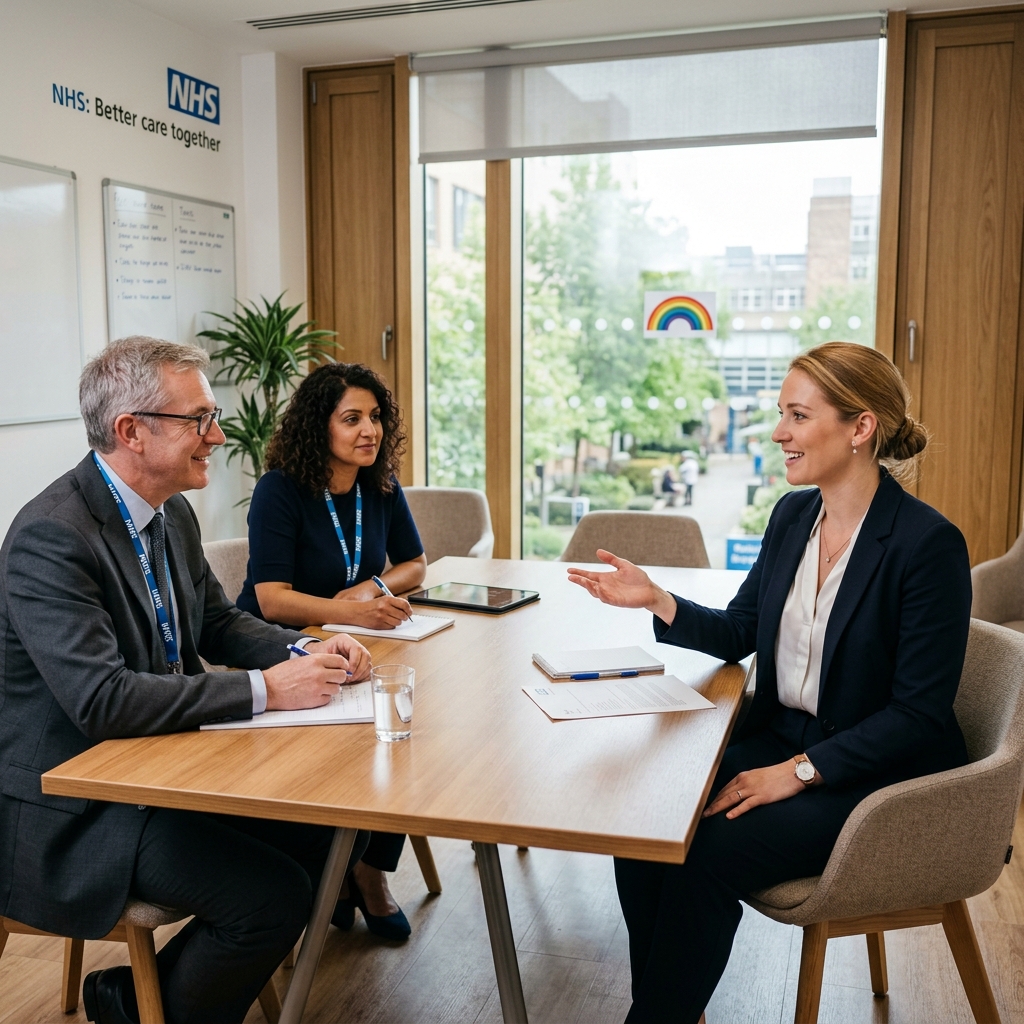
The NHS Interview Panel: How You Are Scored
To pass the interview, you must understand how the panel evaluates you. NHS hiring panels usually consist of 2 to 3 staff members (typically the department manager, a senior administrator, and sometimes a human resources representative).
- The Scoring Matrix: For every question asked, the interviewers have a pre-defined sheet containing key "indicators" they want to hear. Each answer is scored on a scale (typically 1 to 5). To get a 5, you must not only answer the question but also demonstrate the target competency, mention relevant protocols, and link your outcome to NHS values.
- Values-Based Recruitment (VBR): The NHS employs Values-Based Recruitment. This means they are checking whether your personal ethics align with the system's values: Compassion, Respect and Dignity, Commitment to Quality of Care, Working Together for Patients, Improving Lives, and Everyone Counts.
- The "I" Rule: When describing teamwork, many candidates make the mistake of saying "We did this" or "Our team resolved that." The panel is interviewing you, not your previous team. You must explicitly state what you did: "I triaged the inbox," "I escalated the concern," or "I implemented the spreadsheet."
Deconstructing the STAR Method for Healthcare
The STAR method is a structured technique used to answer behavioral and competency-based questions. Let us look at how to tailor it specifically for healthcare administrative contexts.
Situation (10% of your answer)
Set the scene. Describe the context of the challenge you faced. Keep it brief and professional.
- Example: "In my previous role as a Band 3 receptionist at a busy GP clinic, we experienced a sudden outage of our EMIS Web database during morning check-ins."
Task (10% of your answer)
Identify the problem, goal, or challenge that needed solving.
- Example: "I needed to ensure that the 45 patients arriving for their appointments were checked in accurately, clinical staff were informed of arrivals, and confidentiality was maintained without access to digital records."
Action (60% of your answer)
This is the most critical part of your response. Explain the step-by-step actions you took. Detail the systems, regulations, and interpersonal skills you utilized.
- Example: "I immediately retrieved our physical emergency continuity folder and printed the offline emergency clinic lists that were automatically backed up to our local drive. I established a temporary manual sign-in sheet at the front desk, ensuring that patients signed on individual slips of paper to maintain data privacy in line with GDPR. I then walked to the consultation rooms to hand-deliver the patient lists to the GP and nurse practitioners, ensuring clinical staff knew the order of arrivals."
Result (20% of your answer)
Explain the outcome. Quantify the result if possible, and reflect on what you learned or how it aligned with your commitment to patient care.
- Example: "As a result, all 45 patients were seen within 15 minutes of their scheduled times, zero administrative errors occurred, and patients remained calm because I explained the situation transparently. The practice manager commended my fast action, and we updated our emergency protocol based on my feedback."
If you want to practice structuring your verbal responses under pressure, you can use our interactive AI Interview Coach to simulate a real NHS panel interview and receive instant feedback on your pacing, keyword usage, and STAR alignment.
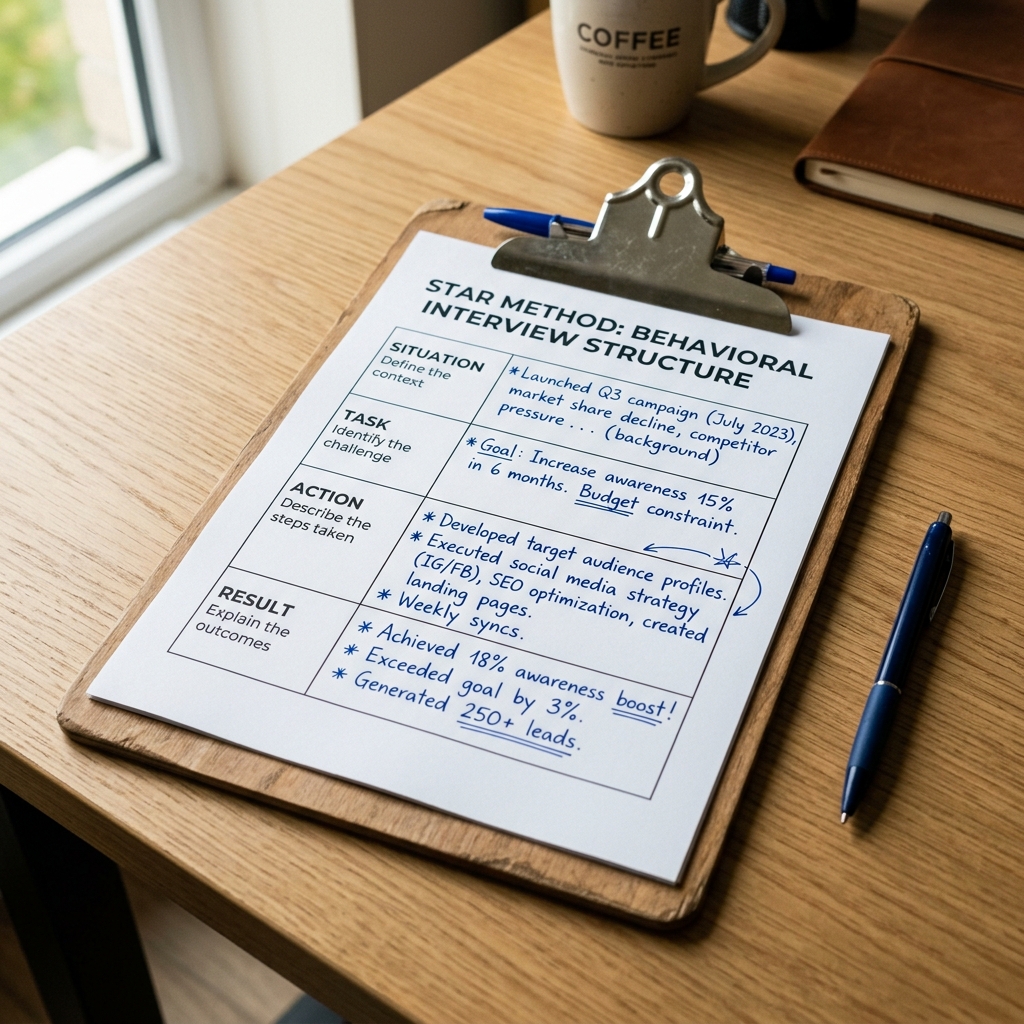
Top 6 NHS Administrative Interview Questions & STAR Answers
Question 1: "How do you prioritize multiple competing tasks when working in a high-pressure clinical environment?"
What they are looking for: Prioritization techniques (e.g., urgent vs. important), task management systems, and the ability to maintain composure when clinicians and patients are demanding attention simultaneously.
Situation: While working as a Ward Administrator in a busy acute medical unit, I was simultaneously asked by a consultant to locate an urgent discharge summary, had a patient’s relative at the desk requesting an update, and had the telephone ringing with an incoming transfer request from another department.
Task: I needed to manage all three requests efficiently, maintaining a calm and professional demeanor while ensuring clinical safety and patient dignity were not compromised.
Action: I began by prioritizing the requests based on clinical urgency and safety. The incoming phone call regarding the patient transfer had the highest immediate clinical impact, so I answered the phone, requested the colleague hold for 30 seconds, and addressed the immediate query. I politely acknowledged the relative at the desk, saying: "I will be with you in just one moment," to manage their expectations. I then completed the transfer call, recording the patient details on our PAS system. Next, I addressed the patient's relative with empathy, answering their non-clinical query and guiding them to the family waiting area. Finally, I located the consultant's discharge summary on the system and sent it securely, ensuring no delay in the discharge pathway.
Result: All three tasks were resolved within five minutes. The relative expressed appreciation for being acknowledged, the transfer occurred safely, and the discharge was completed on time. I maintained control of the workspace by systematically indexing my tasks using our digital queue system.
Question 2: "Describe a time when you had to deal with an upset or angry patient or member of the public."
What they are looking for: Empathy, active listening, de-escalation skills, adherence to trust policy, and understanding when to escalate to security or senior management.
Situation: At an outpatient clinic reception desk, a patient arrived 40 minutes late for their appointment due to public transport delays and became highly distressed and aggressive when told the clinic list was full and they might not be seen.
Task: I needed to de-escalate the patient's anger, actively listen to their concerns, maintain a safe reception environment, and find a solution that respected both the patient and the clinic schedule.
Action: I remained calm and spoke in a soft, reassuring tone. I stepped slightly to the side of the desk to offer a more private space, ensuring I respected their dignity. I listened without interrupting as they explained their transport frustration. Once they finished, I validated their feelings, saying: "I understand how stressful it is to travel when public transport is delayed, and I want to help you." I checked our booking system and noticed a cancellation later in the afternoon. I explained the situation to the clinical lead to see if they could accommodate a slot, and they agreed to see the patient if they could wait.
Result: The patient immediately calmed down, apologized for their initial tone, and agreed to wait. They were seen later that afternoon, avoiding a complete cancellation of their appointment. This demonstrated my commitment to the NHS value of compassion by putting the patient's well-being first.
Question 3: "How do you ensure patient confidentiality and data protection in your daily work?"
What they are looking for: Deep understanding of GDPR, NHS Information Governance, Caldicott Principles, and practical daily habits (e.g., locking screens, securing physical files).
Situation: In my role as a Medical Secretary, I was typing a confidential referral letter containing sensitive patient history while sitting at a desk in a shared office space where external IT contractors were performing maintenance.
Task: I had to ensure that the patient’s clinical data remained completely confidential and was not exposed to unauthorized individuals during my workday.
Action: I adhered strictly to our Information Governance guidelines. I positioned my dual monitors so they were angled away from the door and public pathways, and I applied a privacy filter to my screen. When one of the contractors approached my desk to check a network port, I immediately locked my computer screen using the 'Windows + L' shortcut, even though I was only stepping away for a moment. I ensured that no printed clinic lists or patient notes were left face-up on my desk, putting them into a locked desk drawer instead. I also verified the identity of the contractors by checking their NHS Trust badges before allowing them near any hardware.
Result: The patient's data remained completely secure, and I maintained full compliance with the Caldicott Principles. Adhering to these habits daily ensures that our department maintains a zero-breach record for information security.
Question 4: "Can you give an example of an administrative process you improved in your previous role?"
What they are looking for: Proactivity, organizational skills, familiarity with digital systems (e.g., MS Excel, scheduling databases), and commitment to quality of care.
Situation: In a community health clinic, our department used a shared email inbox to receive clinical referrals. Because there was no tracking system, referrals were occasionally missed or double-booked, causing delays in patient care.
Task: I took the initiative to design a tracking system to ensure every referral was processed within our 48-hour service level agreement (SLA).
Action: I created a shared tracker on MS Teams using Excel, categorization tags, and automated alerts. I mapped out the process, assigning specific team members to triage the inbox on rotating shifts. I color-coded the referrals based on urgency (Red for urgent, Amber for routine) and included columns for the patient's NHS number, referral date, clinician assigned, and current status. I then led a 15-minute training session for the administrative team to ensure everyone understood how to update the system.
Result: Within three0 days of implementing the tracker, the number of outstanding referrals dropped to zero, and our processing time went from an average of 72 hours to under 24 hours. The clinical lead praised the system as it provided complete transparency over patient pathways.
Question 5: "Tell me about a time you had to work with a difficult colleague or resolve a communication issue within a team."
What they are looking for: Collaboration, emotional intelligence, constructive communication, and the NHS value of "working together for patients."
Situation: During a departmental restructuring, a senior medical secretary was consistently late in sending patient letters for my clinical team, which caused delays in updating GP records.
Task: I needed to address this delay constructively to ensure our patient communications met our trust's quality standards, without creating conflict within our team.
Action: Instead of sending an email or complaining to our manager, I invited the colleague for a private cup of tea. I explained the challenge I was facing, saying: "I want to make sure our patients get their GP letters on time, but I've noticed a delay in our queue. Is there anything I can do to help you with the intake?" The colleague opened up and explained they were struggling with a new voice-recognition typing software and felt overwhelmed. I offered to share some keyboard shortcuts and templates I had developed to speed up transcription.
Result: The colleague appreciated the support and adopted my templates. Within two weeks, our letter queue was back to normal, and our working relationship strengthened significantly. This proved that empathy and collaboration are the most effective tools for resolving team friction.
Question 6: "How would you handle a situation where you realized you made an administrative mistake?"
What they are looking for: Honesty, accountability, immediate correction strategies, and learning to prevent future occurrences.
Situation: While processing a batch of outpatient referrals, I realized I had booked a patient for a diagnostic scan on the wrong date, which meant they would arrive when the specialist was not on site.
Task: I had to take immediate responsibility, correct the error before the patient arrived, and implement steps to prevent this error from happening again.
Action: As soon as I identified the mistake, I informed my office manager to ensure transparency. I then immediately phoned the patient. I apologized sincerely for the scheduling error, explained that we had to adjust their slot to ensure they saw the specialist, and offered them a choice of three alternative dates. Once the patient selected a new date, I updated the booking system, sent a confirmation letter, and called the clinical lead to verify the slot was secure. To prevent this from recurring, I added a double-check step to my workflow: verifying the clinician's rota against the patient's booking date before pressing save.
Result: The patient was rescheduled successfully without arriving at an empty clinic, and they expressed appreciation for my prompt call. By taking immediate accountability, I maintained trust and improved my own attention to detail.
Frequently Asked Questions
What should I do if I cannot think of a healthcare-related example during the interview?
It is perfectly acceptable to draw examples from non-healthcare environments, such as retail, call centers, hospitality, or corporate office roles. The key is to focus on transferable skills. If asked about prioritizing tasks, use an example of managing customer orders or resolving stock issues under pressure. Reframe the story to emphasize organization, data integrity, and excellent communication, explaining how these skills directly translate to an NHS setting.
How long should my STAR answers be?
Ideally, a STAR response should take between 2 to 3 minutes to deliver verbally. If your answer is under 1 minute, you likely missed critical details about your actions. If it exceeds 4 minutes, you may be providing too much background context. Aim to spend the majority of your time (around 60%) explaining the "Action" phase—detailing exactly what you did, the protocols you followed, and the systems you used.
What is the difference between Band 3 and Band 4 interview expectations?
Band 3 roles (e.g., Clinic Receptionists, Ward Clerks) focus on day-to-day operational support, data entry accuracy, and patient-facing customer service. The interview will focus on basic administration, empathy, and following procedures. Band 4 roles (e.g., Medical Secretaries, Clinic Coordinators) demand higher levels of independence, specialized medical terminology, and pathway management. The interview will require you to demonstrate problem-solving, managing complex diaries, and coordinating with senior clinical staff.
How do I research the specific NHS Trust before my interview?
Visit the Trust’s public website and read their latest annual report, CQC (Care Quality Commission) rating, and their stated values or mission statement. Mentioning a specific initiative the Trust is running—such as a new digital health integration or a community outpatient project—shows the panel that you have a genuine interest in their organization and have done your homework.
What are Caldicott Guardians and why are they mentioned in admin interviews?
A Caldicott Guardian is a senior person in an NHS organization responsible for protecting the confidentiality of patient information and enabling appropriate information sharing. Mentioning your understanding of the Caldicott Guardians and their role in safeguarding data integrity shows the interview panel that you have a mature understanding of healthcare information security.
Can I use personal or academic examples for STAR questions?
Yes, especially if you are a graduate or changing careers. You can use examples from university projects, volunteering, or managing personal events. The same rules apply: structure your story using Situation, Task, Action, and Result, and focus on the administrative, organizational, and interpersonal skills you demonstrated during the project.
The NHS Administrative Interview Checklist
Before you walk into the interview room or log onto your online interview call, ensure you have completed these steps:
- Memorized Your STAR Stories: Have 4 to 6 flexible stories prepared that cover prioritization, handling difficult patients, managing data, and team collaboration.
- Read the Trust’s Values: Be ready to name the Trust’s specific values and link them to your personal work ethics.
- Reviewed Clinical Terminology: Familiarize yourself with basic acronyms (GDPR, PAS, EHR, CQC) so you can reference them naturally.
- Practiced Out Loud: Speak your answers aloud to ensure you are using "I" instead of "We" and keeping your pacing steady.
- Prepared Your CV: Ensure you have reviewed your CV details so your verbal answers match your application history. If you need to rebuild your document before submitting it to another Trust, you can utilize our CV Builder to ensure it aligns with the NHS format.
Taking the time to structure your experiences using the STAR method is what separates average candidates from those who secure job offers. By combining a safety-first mindset, a commitment to patient dignity, and clear communication, you will stand out as a highly professional candidate who is ready to support the clinical team.
Practice with our AI Mock Interviewer
Simulate real interviews, get instant feedback, and build confidence before the big day.
Start PracticingWritten by
Mehmet Kerem Mutlu
Founder of AlignCV · Mechanical Engineering Student
Mehmet Kerem is a mechanical engineering student and the founder of AlignCV — an AI-powered career platform built to help every job seeker land their next role with confidence. Combining his engineering mindset with a passion for product development, he designs tools that make CV writing, cover letter generation, and interview preparation faster and smarter. He writes about career strategy, AI in hiring, and the future of work.