

Industrial engineering in 2026 sits at the critical intersection of physical manufacturing, digital supply chains, and business process automation. Modern industrial engineers are tasked with eliminating waste, optimizing complex systems, and driving operational efficiency in sectors ranging from automotive gigafactories and aerospace plants to automated e-commerce fulfillment centers.
To land a premium role, your resume must demonstrate a mastery of process control, system modeling, and data analysis. Employers look for candidates who can prove how they applied methodologies like Lean, Six Sigma, and Value Stream Mapping (VSM) to recover costs and expand capacity.
If you are updating your resume, you can utilize our CV Builder to format your document using templates built for technical sectors. You can also run a quick compliance scan using our ATS Optimizer to ensure your skills are properly structured for recruiting platforms.
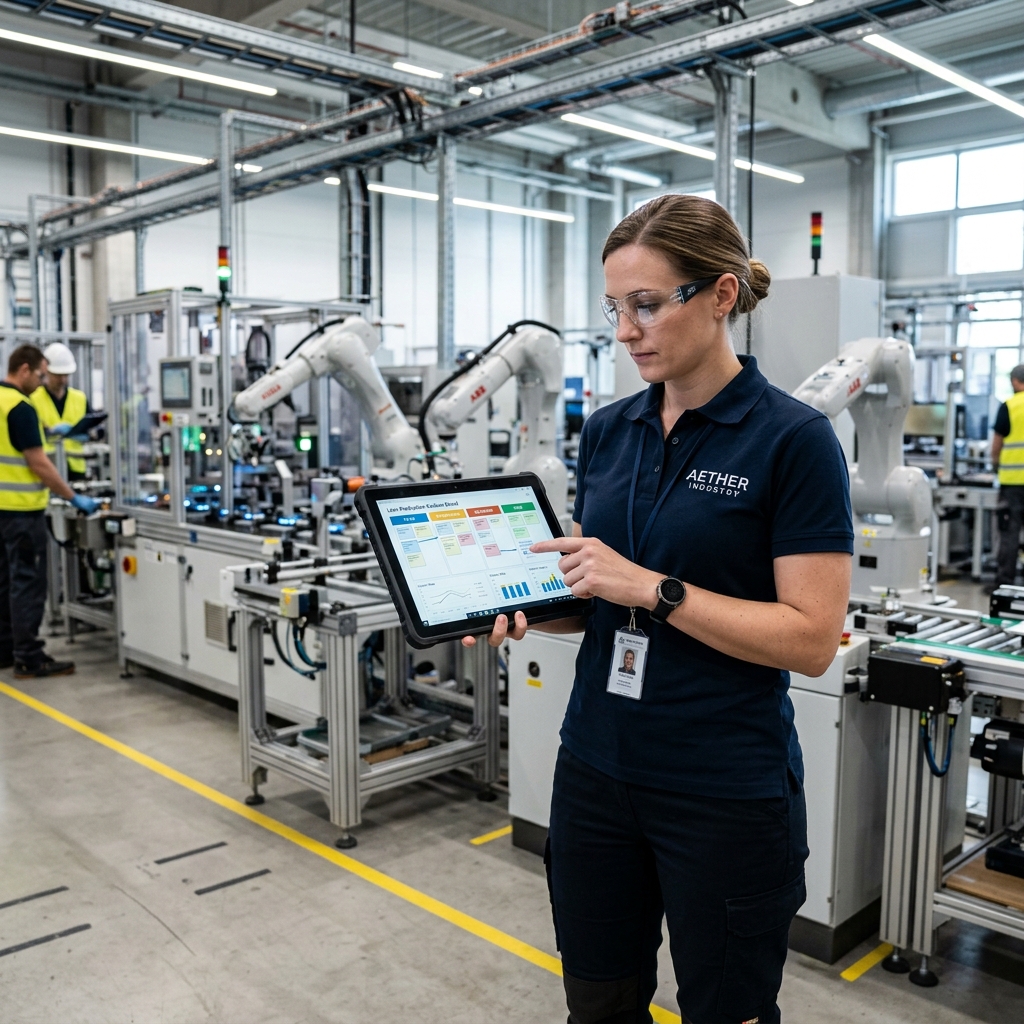
The Industrial Engineering Core Skills Matrix
Structure your technical skills directly below your summary statement. Grouping your skills ensures that hiring managers can instantly identify your software, methodology, and operations capabilities.
| Lean & Six Sigma | Systems Simulation & CAD | Operations & Logistics | Data & Analytics |
|---|---|---|---|
| Value Stream Mapping (VSM) | Arena / Simio Simulation | Facility Layout (AutoCAD) | Minitab (SPC / ANOVA) |
| DMAIC Methodology | SolidWorks / AutoCAD | Supply Chain Optimization | Python / R (Data Analysis) |
| Root Cause Analysis (5 Whys) | Witness / FlexSim | Inventory Control (MRP/ERP) | SQL / Power BI |
| Kaizen / Kanban / 5S | Process Flow Simulation | Line Balancing & Cycle Time | Advanced MS Excel |
Quantifying Your Process Improvements
Hiring managers in operations and manufacturing evaluate candidates based on their quantitative results. Avoid listing passive statements like "Responsible for improving line efficiency." Instead, frame your achievements using key performance indicators (KPIs) such as Overall Equipment Effectiveness (OEE), cycle times, and scrap rates.
- Instead of: "Led Lean manufacturing workshops on the shop floor."
- Use: "Facilitated four Kaizen events on a high-speed packaging line, implementing 5S and visual management standards that boosted OEE from 72% to 84%."
- Instead of: "Redesigned plant layouts to save space."
- Use: "Designed an optimized cellular manufacturing layout using AutoCAD, reducing material transport distances by 35% and saving 1,200 square feet of floor space."
- Instead of: "Responsible for tracking production capacity and bottlenecks."
- Use: "Identified line bottlenecks using Arena simulation software, redistributing work elements to balance cycle times and expanding daily production capacity by 18% without adding headcount."
If you want to practice explaining these process improvement methodologies in an upcoming interview, rehearse your responses with our interactive AI Interview Coach.
STAR Method Project Examples for Industrial Engineers
Structure your experience descriptions using the STAR (Situation, Task, Action, Result) framework to showcase your methodical problem-solving capabilities.
Example 1: Reducing Cycle Time on an Assembly Line
Situation: An automotive electronics assembly line was struggling to meet a 15% increase in customer demand, experiencing high workstation idle times due to poor line balancing.
Task: I was assigned to perform a time study, re-balance the 8-station assembly line, and reduce the overall cycle time to match the new target takt time of 42 seconds.
Action: I conducted a video-based time study and mapped the current state using Value Stream Mapping (VSM). I identified that Station 4 was a bottleneck, carrying 58 seconds of work, while Station 6 was idle 40% of the time. I utilized line balancing algorithms to redistribute manual assembly tasks. I designed custom gravity-fed component racks to minimize operator motion (reducing waste under lean principles), and updated the Standard Operating Procedures (SOPs).
Result: The re-balanced assembly line achieved a cycle time of 39 seconds, comfortably below the target takt time. Workstation idle time dropped by 65%, enabling the plant to meet the increased demand and saving £45k in monthly overtime costs.
Example 2: Implementing Six Sigma to Reduce Scrap Rates
Situation: A high-precision plastic injection molding line experienced a 5.2% scrap rate due to dimensional variations in molded components, costing the plant £12,000 weekly in waste.
Task: I was tasked with leading a DMAIC (Define, Measure, Analyze, Improve, Control) project to reduce the defect rate below 1.0%.
Action: I defined the defect criteria and measured baseline process capability (yielding a poor Cp/Cpk of 0.85). In the Analyze phase, I used Minitab to run a Multi-Vari study and identified mold temperature and injection pressure as critical factors. In the Improve phase, I ran a Design of Experiments (DOE) to establish optimal parameter windows. In the Control phase, I implemented statistical process control (SPC) charts on the line to monitor parameters in real-time.
Result: The process capability index (Cpk) improved to 1.42, and the scrap rate dropped from 5.2% to 0.75%. The reduction in scrap saved the manufacturing facility over £280k annually.
Frequently Asked Questions
Which certifications are most important for industrial engineers?
A Six Sigma Green Belt or Black Belt certification is highly valued, as it proves your mastery of statistical process controls and DMAIC methodology. Certifications from professional bodies like the Institute of Industrial and Systems Engineers (IISE) or the Association for Supply Chain Management (ASCM) (such as CPIM or CSCP) are also highly recommended.
How do I highlight experience with automation and Industry 4.0?
Explicitly mention your work with automated systems, robotics, programmable logic controllers (PLCs), or IoT sensors. For example, write: "Integrated IoT sensors on a CNC machining line to collect real-time cycle data, enabling predictive maintenance schedules and reducing unscheduled downtime by 12%."
Should I include supply chain experience on my resume?
Yes, absolutely. Industrial engineering and supply chain operations are closely linked. Highlight experience with material requirements planning (MRP) systems, warehouse management systems (WMS), inventory optimization, and logistics bottleneck analysis.
How do I write about process mapping?
Specify the tools and methods you used. Instead of "mapped processes," write "mapped current and future state processes using Value Stream Mapping (VSM) in MS Visio." Explain the outcome of the mapping, such as identifying non-value-added steps.
Industrial Engineer Resume Checklist
Perform this final review before submitting your CV to recruiters:
- Six Sigma Credentials Highlighted: Green Belt or Black Belt status is prominent.
- Quantified Process Metrics: Bullet points include concrete numbers for cycle times, OEE, or cost savings.
- Simulation Software Listed: Arena, FlexSim, or Simio tools are explicitly named.
- No Double Quotes inside Blockquotes: Verify all blockquotes are free of manual double quotes.
- Three Short Tags: The post's frontmatter contains exactly three short, relevant tags.
- Relative Internal Links: All links to the builder, optimizer, and interview coach are relative.
Ready to build your perfect CV?
AlignCV helps you create ATS-friendly CVs and tailored cover letters with AI.
Create Your CV NowWritten by
Mehmet Kerem Mutlu
Founder of AlignCV · Mechanical Engineering Student
Mehmet Kerem is a mechanical engineering student and the founder of AlignCV — an AI-powered career platform built to help every job seeker land their next role with confidence. Combining his engineering mindset with a passion for product development, he designs tools that make CV writing, cover letter generation, and interview preparation faster and smarter. He writes about career strategy, AI in hiring, and the future of work.