

Achieving a Band 7 or higher on the IELTS Speaking test in 2026 is less about trying to sound like a native English speaker and more about demonstrating effortless, natural communication. Many candidates fail to reach a Band 7 because they focus too heavily on memorizing complex words or complex grammatical structures, which results in robotic, halting speech.
To score high, you must prove you can speak at length without noticeable effort or loss of coherence. The examiner wants to see that you can navigate language gaps smoothly, use natural conversational fillers, and organize your thoughts logically.
If you are preparing for international study or a visa application, you can use our CV Builder to create a clean, professional resume. To build your confidence and practice delivering fluent spoken responses under pressure, try running a simulated conversation with our interactive AI Interview Coach.
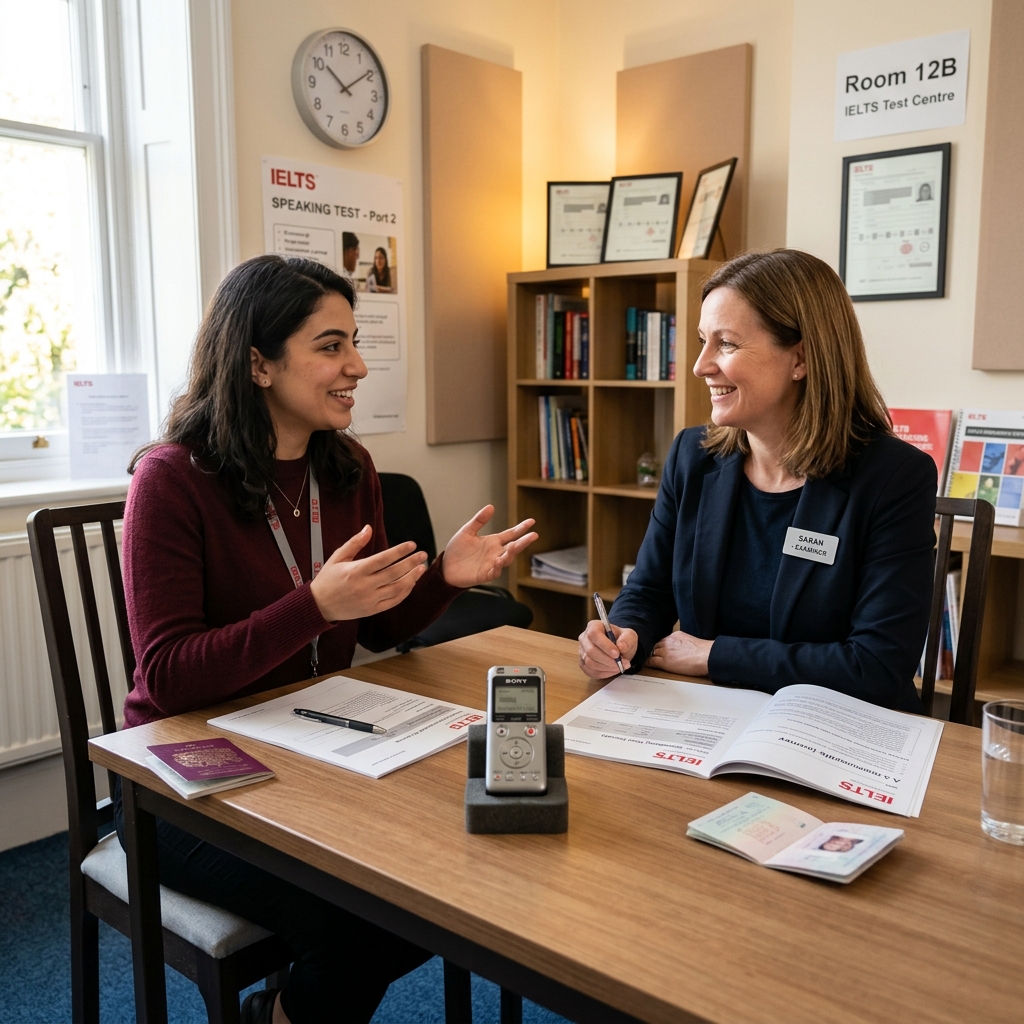
The Four Scoring Criteria Explained
The IELTS Speaking test is scored across four equal areas. Knowing what the examiner is evaluating helps you focus your practice:
- Fluency and Coherence (25%): Your ability to speak smoothly, maintain a natural pace, connect your ideas logically, and recover from language hesitations.
- Lexical Resource (25%): Your vocabulary range. To hit Band 7, you must show you can use idiomatic language and choose words flexibly to discuss a variety of topics.
- Grammatical Range and Accuracy (25%): Your ability to use a mix of simple and complex sentence structures accurately.
- Pronunciation (25%): Your clarity. This includes word stress, sentence intonation, and rhythm—the examiner must be able to understand you without effort.
4 Strategies to Sound Natural and Fluid
1. Master Conversational Fillers (Delaying Tactics)
When native speakers need time to organize their thoughts, they do not remain completely silent or repeat "um" and "uh" excessively. Instead, they use filler phrases. Mastering these phrases allows you to buy thinking time while maintaining your fluency score.
- Instead of silence or "uh..."
- Use: That is a challenging question, let me think about that for a second...
- Use: Off the top of my head, I would say...
- Use: I have not really thought about that before, but if I had to choose...
- Use: That is a common debate, and from my perspective...
2. Apply the "Answer + Reason + Example" Template
In Part 1 and Part 3 of the test, never give short, one-sentence answers. Use the ARE structure to extend your answers naturally:
- A - Answer: State your direct response to the question.
- R - Reason: Explain why you hold that opinion.
- E - Example: Provide a personal anecdote or a general example to support your point.
Question: Do you enjoy traveling by public transport?
Answer: Generally speaking, yes, I quite enjoy using public transport, particularly trains.
Reason: The main reason is that it allows me to relax and read a book rather than having to focus on the stress of navigating city traffic.
Example: For instance, when I commute to work in the mornings, I find that taking the train gives me a quiet 30 minutes to organize my thoughts before the day begins.
3. Handle Vocabulary Gaps Gracefully
Band 7 candidates still forget specific words. The difference is how they handle the gap. Instead of stopping the conversation to search for the exact word, paraphrase it.
- If you forget the word "colleague":
- Say: My coworker... or rather, the person I share an office space with at my company.
- If you forget the word "scrapper" or "demolition":
- Say: The machines that are used to break down old buildings.
This demonstrates to the examiner that you have the vocabulary flexibility to explain complex concepts even when a specific term slips your mind.
4. Focus on Rhythm, Not Speed
Many candidates believe that speaking fast is the key to fluency. In reality, speaking too quickly leads to more grammatical mistakes, slurred pronunciation, and a loss of coherence. Aim for a steady, rhythmic pace. Use pauses naturally at the ends of clauses and sentences, just as you would in your native language.
Practical Training Exercises for Band 7+
- The 2-Minute Monologue Challenge: Pick a common IELTS Part 2 topic (such as describing a favorite book or a memorable journey). Start a timer, and record yourself speaking for exactly 2 minutes. Listen to the recording and count the number of hesitations or "umms." Repeat the exercise, focusing on reducing hesitations by using filler phrases.
- Vocabulary Grouping: Group vocabulary by common IELTS topics (such as Environment, Education, Technology, and Culture). Practice writing down 3 nouns, 3 verbs, and 3 adjectives for each topic so you can access them easily during the test.
- Intonation Mimicking: Listen to short English podcasts or news broadcasts. Pause the audio after each sentence and mimic the speaker's rise and fall in tone. This helps build a natural, expressive rhythm.
Frequently Asked Questions
Can I ask the examiner to repeat a question?
Yes. If you did not hear or understand a question, you can ask the examiner to repeat or clarify it. You can say: "Could you repeat that, please?" or "Could you explain what you mean by [word]?" This is a natural communication skill and will not lower your score, provided you do not do it for every question.
Should I speak with a British or American accent?
No. You do not need to speak with a native British or American accent. The examiner is testing your pronunciation clarity and word stress, not your regional accent. As long as your speech is clear, easy to understand, and your pronunciation of individual words is accurate, you can achieve a Band 9.
What should I do if I make a grammatical mistake?
If you realize you made a mistake, correct it immediately and move on. For example: "Yesterday I go... sorry, yesterday I went to the store." Self-correction shows the examiner that you have control over your grammar. However, if you do not realize the mistake immediately, do not pause or go back; keep speaking to protect your fluency score.
IELTS Speaking Success Checklist
Review this checklist to prepare for test day:
- Conversational Fillers Memorized: At least three natural filler phrases are ready for use.
- Paraphrasing Strategy Ready: You are prepared to describe concepts when specific words are forgotten.
- ** steady Pacing Practiced**: You focus on clear, rhythmic delivery rather than speed.
- No Double Quotes inside Blockquotes: Verify all blockquotes are free of manual double quotes.
- Three Short Tags: The post's frontmatter contains exactly three short, relevant tags.
- Relative Internal Links: Verify links point correctly to the builder, optimizer, and interview coach.
Practice with our AI Mock Interviewer
Simulate real interviews, get instant feedback, and build confidence before the big day.
Start PracticingWritten by
Mehmet Kerem Mutlu
Founder of AlignCV · Mechanical Engineering Student
Mehmet Kerem is a mechanical engineering student and the founder of AlignCV — an AI-powered career platform built to help every job seeker land their next role with confidence. Combining his engineering mindset with a passion for product development, he designs tools that make CV writing, cover letter generation, and interview preparation faster and smarter. He writes about career strategy, AI in hiring, and the future of work.