

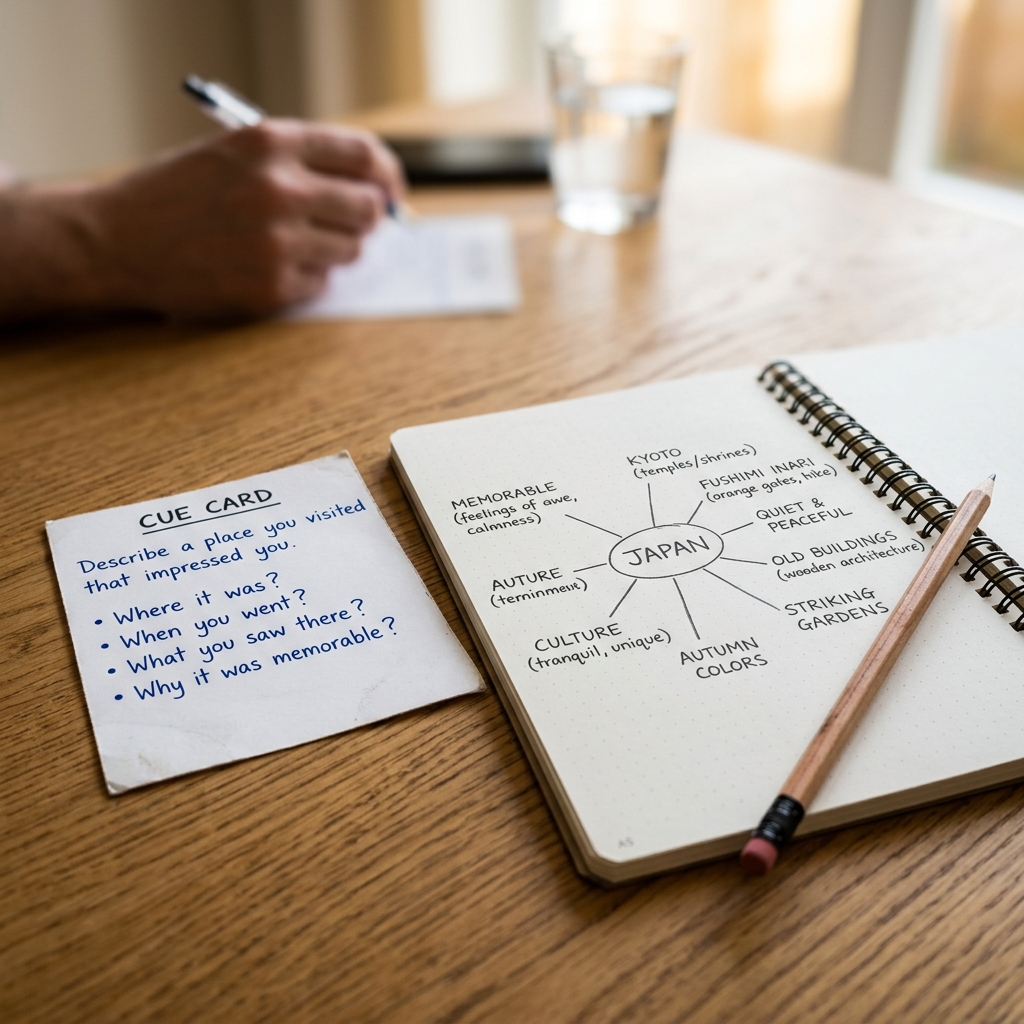
IELTS Speaking Part 2, also known as the "Long Turn" or "Cue Card" section, is where many candidates lose marks. In this section, you are handed a card with a topic and four prompts, given exactly 60 seconds to plan and make notes, and asked to speak continuously for 1 to 2 minutes.
Many candidates run out of things to say after 45 seconds, resulting in a low score for Fluency and Coherence. To achieve a Band 7 or higher, you must keep talking until the examiner interrupts you at the 2-minute mark.
If you are updating your international academic or immigration applications, you can use our CV Builder to format a professional resume. To practice answering cue cards under real-time constraints and receive instant grading on your fluency, try our interactive AI Interview Coach.
4 Common Cue Card Categories
Almost every IELTS Speaking Part 2 question falls into one of these four categories:
- Describe a Person: e.g., a teacher who inspired you, a successful businessman, a family member you admire, or a famous celebrity.
- Describe a Place: e.g., a city you visited, a building you find interesting, a park in your town, or a country you want to travel to.
- Describe an Object: e.g., a piece of technology you use daily, a gift you received, a book that influenced you, or a piece of art.
- Describe an Event / Experience: e.g., a time you made a mistake, a celebration you enjoyed, a project you completed, or a choice you made.
The 60-Second Planning Brainmap
Do not make the mistake of writing full sentences during your 1-minute planning time. Writing full sentences is slow and forces you to read from your notes during the test, which ruins your eye contact and natural intonation.
Instead, draw a quick brainmap containing:
- A central keyword answering the main question.
- Four branches answering the prompts (Who/What, When, Where, Why).
- 3-4 advanced vocabulary terms you want to weave into your response.
The PPF (Past, Present, Future) Expansion Framework
If you only answer the four prompts on the cue card, you will likely finish speaking in under one minute. To extend your monologue naturally to two minutes and demonstrate a wide grammatical range, use the PPF framework:
1. The Past (Background)
Spend the first 30 seconds describing the history of the topic. How did you first learn about this person, place, or object?
- Transition phrase: I first encountered this about three years ago, when I was...
2. The Present (Current Situation)
Spend the next 45 seconds describing the current details. What is it like now? How often do you interact with it?
- Transition phrase: Turning now to the present day, I find that I...
3. The Future (Hypothetical/Expectations)
Spend the final 45 seconds discussing the future. How do you plan to interact with this topic moving forward?
- Transition phrase: Looking ahead, if I had the opportunity, I would definitely...
By shifting tenses across past, present, and future, you prove to the examiner that you have control over complex verb structures, which boosts your Grammatical Range score.
Sample Cue Card and Model Response
The Cue Card
Describe a useful piece of technology that you use daily.
- What it is.
- How long you have had it.
- What you use it for.
- Explain why it is useful to you.
Model Transcript (Band 7.0+)
I would like to talk about my noise-canceling headphones, which have become an indispensable part of my daily routine. I first acquired them about two years ago, when I transitioned to a remote-working role at my company. I realized that my apartment building could be quite noisy, so I decided to invest in a premium pair of headphones to help me maintain concentration.
Currently, I use them almost constantly throughout the working day. They are primarily utilized for connecting to virtual team meetings and filtering out background noise, such as traffic or construction. Beyond my professional tasks, I also wear them when I am commuting on public transit to listen to podcasts or classical music. They are exceptionally useful because they feature an active noise-cancellation setting, which electronically blocks ambient sounds, allowing me to focus completely.
Looking ahead, I plan to continue using this technology for the foreseeable future. Although new models are released annually, I believe my current pair is sufficiently durable to last another few years. If I had to travel long-distance for a business trip, they would be the first item I would pack.
Frequently Asked Questions
What happens if I speak for less than one minute?
If you speak for less than 60 seconds, you will receive a major penalty score for Fluency and Coherence. The examiner will prompt you to keep talking (e.g., by asking: "Can you tell me more about that?"). Always practice using the PPF framework to ensure you can sustain your monologue.
What should I do when the examiner stops me?
If you are still speaking when the timer hits 2 minutes, the examiner will interrupt you to move to Part 3. Do not panic; this is a positive sign. It proves you have the fluency to speak at length, and you will not lose marks for not finishing your story.
Can I look at my notes while speaking?
Yes. You can refer to your scratch notes throughout your monologue. However, do not read from them word-for-word. Use them as quick visual triggers to keep your thoughts organized while maintaining eye contact and natural gestures.
IELTS Speaking Part 2 Checklist
Verify your monologue preparation against these standards:
- Mind-Mapping Practiced: You can draw a vocabulary and branch map in 60 seconds.
- PPF Framework Integrated: You practice shifting tenses from past to future.
- Pacing Controlled: You speak at a steady, conversational pace without rushing.
- No Double Quotes inside Blockquotes: Ensure blockquote transcripts do not contain manual double quotes.
- Three Short Tags: The post's frontmatter contains exactly three short tags.
- Relative Internal Links: Verify links point correctly to the builder, optimizer, and interview coach.
Practice with our AI Mock Interviewer
Simulate real interviews, get instant feedback, and build confidence before the big day.
Start PracticingWritten by
Mehmet Kerem Mutlu
Founder of AlignCV · Mechanical Engineering Student
Mehmet Kerem is a mechanical engineering student and the founder of AlignCV — an AI-powered career platform built to help every job seeker land their next role with confidence. Combining his engineering mindset with a passion for product development, he designs tools that make CV writing, cover letter generation, and interview preparation faster and smarter. He writes about career strategy, AI in hiring, and the future of work.