

The "True, False, Not Given" (TFNG) questions are widely considered the most difficult question type in the IELTS Reading module. Many candidates fail to achieve a Band 7 or higher because they struggle with the logical distinction between a FALSE statement and a NOT GIVEN statement.
Losing focus on these questions can lead to lost points, which is particularly critical given the strict scoring curves. For General Training candidates, you must get 34 out of 40 questions correct for a Band 7.0, leaving very little room for error.
If you are updating your international application materials, you can use our CV Builder to format a professional resume. To build your active reading and verbal synthesis skills, practice with our interactive AI Interview Coach during your study routine.
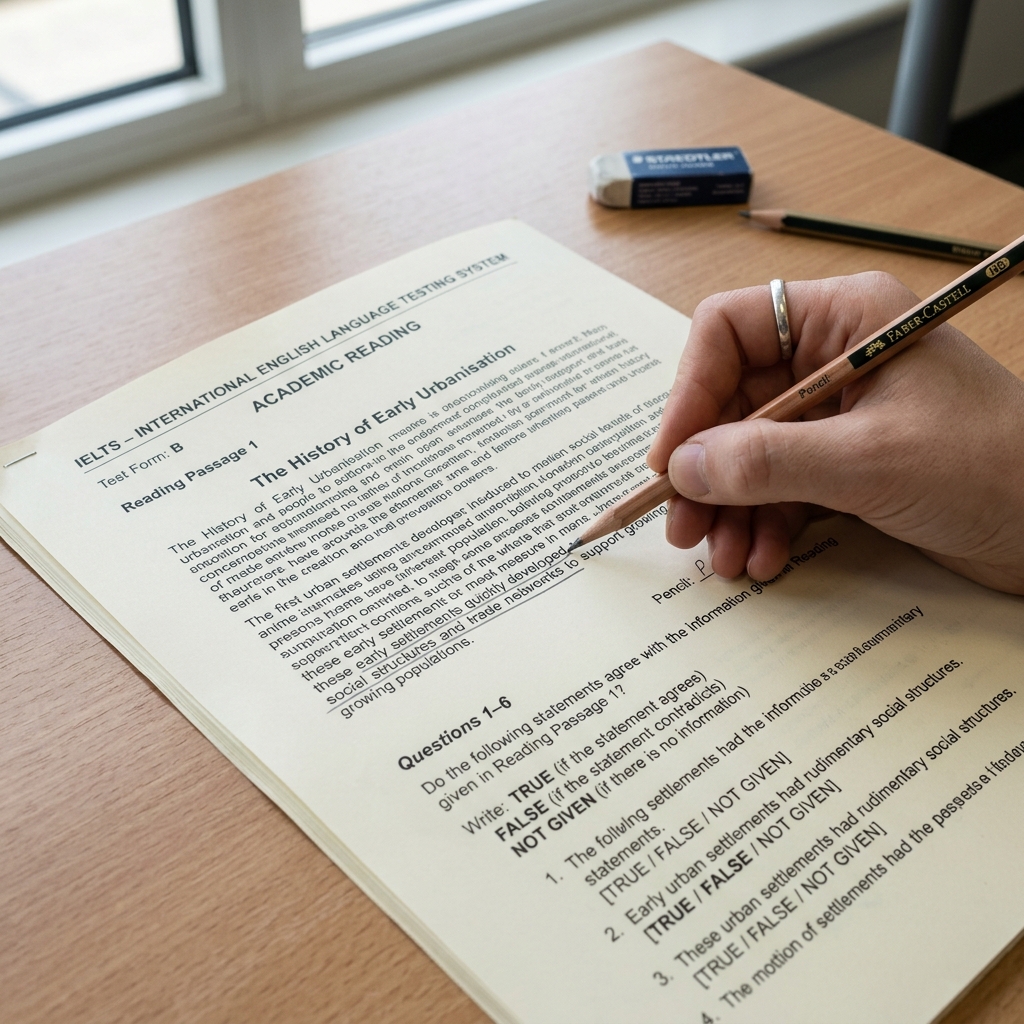
Defining the Logic: True, False, and Not Given
To stop guessing and start scoring, you must understand the exact definitions used by IELTS examiners:
- TRUE: The statement matches the information in the text. The words will not be identical, but the meaning must be 100% the same (paraphrased using synonyms).
- FALSE: The statement directly contradicts or goes against the information in the text. This means the text contains the opposite fact, and you can prove it using a specific sentence.
- NOT GIVEN: The information is not mentioned in the text at all, or there is simply not enough information in the passage to confirm or deny the statement.
The Golden Rule of TFNG
[!IMPORTANT] If you cannot find a sentence in the passage that directly contradicts the statement (meaning the opposite fact is true), then the answer cannot be FALSE. It must be NOT GIVEN.
4-Step Strategy to Solve TFNG Questions
Step 1: Read the Statements First
Always read the statements before you read the passage. Your goal is to understand what you are searching for. Highlight the core keywords in each statement (such as names, dates, numbers, and adjectives).
Step 2: Identify Modifiers and Qualifying Words
Pay close attention to words that limit or qualify the statement. These are the words that examiners use to trap candidates.
- Quantity Modifiers: all, some, many, few, most, none.
- Frequency Modifiers: always, usually, occasionally, rarely, never.
- Probability Modifiers: likely, possibly, definitely, might.
For example, if the statement says "All wind turbines generate electricity in low winds," but the text says "Most wind turbines generate electricity in low winds," the answer is FALSE because "All" contradicts "Most."
Step 3: Scan the Text for Synonyms
Do not search for the exact keywords from the statement. Look for synonyms and paraphrased ideas.
- If the statement has the word "reduce," scan the text for decline, drop, fall, minimize, or decrease.
- The questions follow the order of the passage. The answer to Question 2 will always be found after the answer to Question 1.
Step 4: Compare Meanings, Not Words
Once you locate the relevant section of the passage, compare the meaning of the text to the statement.
- Does it agree? -> TRUE
- Does it contradict (opposite is true)? -> FALSE
- Is it missing or unconfirmed? -> NOT GIVEN
Worked Example: Practice Passage
The Passage
The development of early steam engines in the late 18th century revolutionized British manufacturing. While James Watt is widely celebrated for his improvements to the engine's design, his partner Matthew Boulton managed the commercial expansion of the business, securing vital patent protections. The engines were primarily deployed to pump water out of coal mines, which allowed miners to dig deeper than ever before. Although some historians argue that Boulton's contributions were minor compared to Watt's engineering genius, contemporary letters suggest their partnership was equal.
The Statements and Analysis
Statement 1: James Watt was solely responsible for the commercial success of the steam engine.
- Analysis: The text states that "his partner Matthew Boulton managed the commercial expansion." This directly contradicts the idea that Watt was "solely responsible" for the commercial success.
- Answer: FALSE
Statement 2: The primary application of early steam engines was in coal mining operations.
- Analysis: The text states that "The engines were primarily deployed to pump water out of coal mines." The phrase "primarily deployed" is a synonym for "primary application," and "coal mines" matches "coal mining operations."
- Answer: TRUE
Statement 3: Matthew Boulton was born in Birmingham, England.
- Analysis: While the text discusses Matthew Boulton and his partner James Watt, it does not mention where Boulton was born. There is no information to confirm or deny this.
- Answer: NOT GIVEN
Frequently Asked Questions
What is the difference between TFNG and YNNG (Yes, No, Not Given)?
The strategies are identical. The only difference is the type of text. TFNG questions are used for factual passages, evaluating if statements match the facts. YNNG questions are used for opinion-based or analytical passages, evaluating if statements match the writer's opinions or claims. Always write the exact words required by the instructions (do not write "Yes" if the question asks for "True").
What should I do if I cannot find the answer?
If you have scanned the text for two minutes and cannot find the information, the answer is almost certainly NOT GIVEN. Do not waste time reading the entire passage again. Write "NOT GIVEN" and move to the next question.
Can I write T, F, or NG instead of the full words?
Yes. IELTS examiners accept abbreviations (T, F, NG) on your answer sheet. However, writing the full words (TRUE, FALSE, NOT GIVEN) is recommended to prevent any handwriting clarity issues.
TFNG Strategy Checklist
Verify your exam strategy against these rules before practicing:
- False vs. Not Given Logic Clear: You only choose FALSE if the opposite fact is proven in the text.
- Modifiers Highlighted: Words like all, most, always, sometimes are identified.
- Strict Order Followed: You scan for answers in chronological order through the text.
- No Double Quotes inside Blockquotes: Ensure blockquotes do not contain manual double quotes.
- Three Short Tags: The post's frontmatter contains exactly three short tags.
- Relative Internal Links: Verify links point correctly to the builder, optimizer, and interview coach.
Practice with our AI Mock Interviewer
Simulate real interviews, get instant feedback, and build confidence before the big day.
Start PracticingWritten by
Mehmet Kerem Mutlu
Founder of AlignCV · Mechanical Engineering Student
Mehmet Kerem is a mechanical engineering student and the founder of AlignCV — an AI-powered career platform built to help every job seeker land their next role with confidence. Combining his engineering mindset with a passion for product development, he designs tools that make CV writing, cover letter generation, and interview preparation faster and smarter. He writes about career strategy, AI in hiring, and the future of work.