

The IELTS Listening module can feel overwhelming for beginners. Unlike the Reading module where you can review texts at your own pace, the Listening audio is played only once. If you lose focus for even ten seconds, you can easily miss three or four consecutive answers, leading to panic and a drop in your overall band score.
Most beginners lose marks not because they do not understand English, but because they fall victim to common test traps. These include spelling errors, failing to identify speaker "distractors," and letting a single missed answer derail their concentration for the remainder of the test.
If you are preparing for international university admissions or visa applications, you can use our CV Builder to format a professional resume. To practice active listening and verbal response skills under pressure, rehearse with our interactive AI Interview Coach before test day.
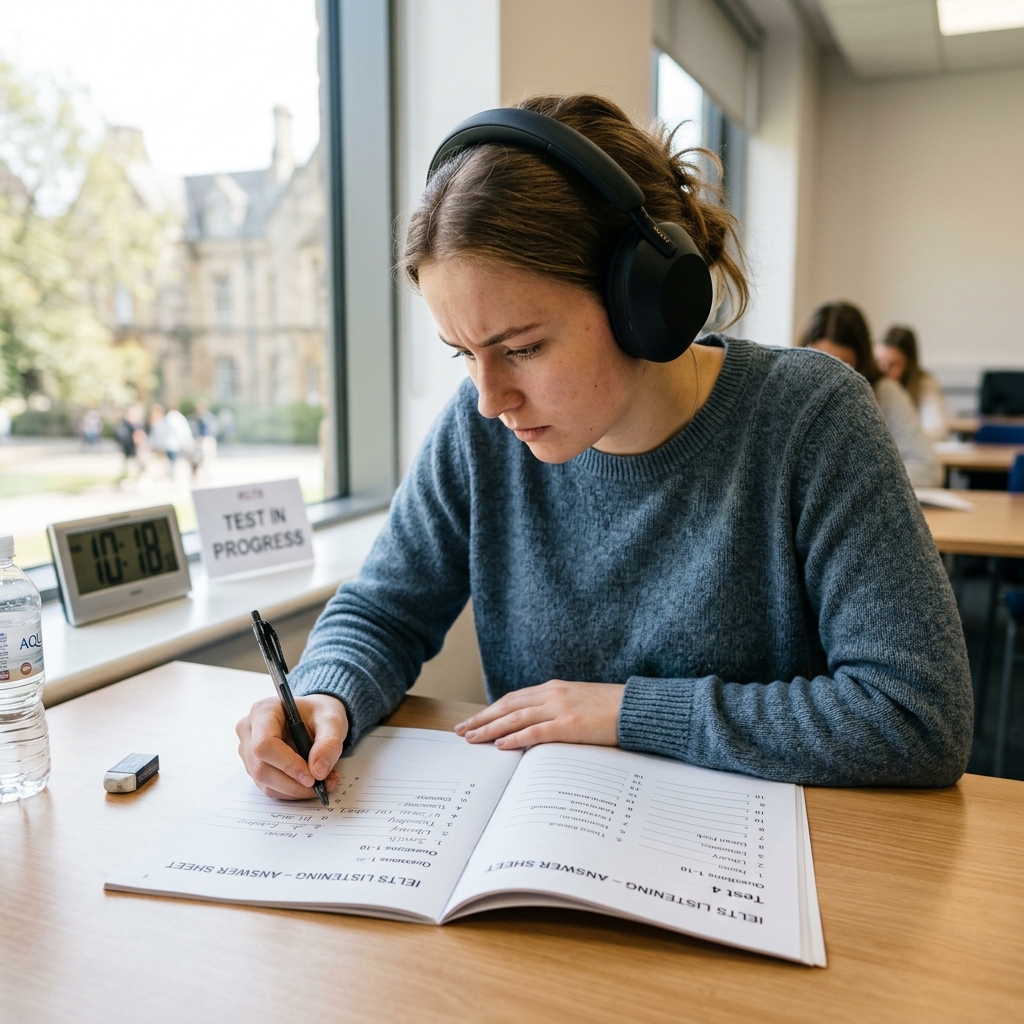
The Listening Test Format at a Glance
Both the IELTS Academic and General Training exams use the exact same Listening test. The test consists of 4 sections with a total of 40 questions, taking approximately 30 minutes to complete (plus 10 minutes of transfer time if you take the paper-based test).
- Part 1: A conversation between two speakers in an everyday social context (e.g. booking a hotel room or registering for a library card).
- Part 2: A monologue in an everyday social context (e.g. a local guide describing a park facility or an announcement about a museum layout).
- Part 3: A conversation between up to four people in an academic or training context (e.g. a university tutor and two students discussing an assignment).
- Part 4: A monologue on an academic or scientific subject (e.g. a university lecture about wildlife conservation or architectural history).
4 Common Beginner Pitfalls and How to Avoid Them
1. Falling for "Distractors" (Self-Corrections)
One of the most common IELTS traps is when a speaker says an answer, only to correct themselves a few seconds later. If you write down the first piece of information you hear without waiting, you will lose points.
Trap Scenario:
Speaker A: My phone number is 07712 345 678.
Speaker B: Let me write that down... 07712 345 678?
Speaker A: Oh, wait, sorry, I gave you my old number! The new one ends in 9, so it is 07712 345 679.
- Strategy: Always listen to the entire sentence before writing down your final answer. Be alert for transition words like sorry, wait, actually, oh, on second thought, or but.
2. Spelling Traps (Double Letters & Plurals)
Spelling must be 100% correct in the IELTS Listening test. An answer that is correct in meaning but misspelled will be marked wrong.
- Double Letters: When spelling names or addresses, speakers often say "double L" or "double E." For example, spelling "Hillary" as "Hilary" due to missing the double letter will result in a zero score.
- Singular vs. Plural: If the audio says "books" and you write "book," your answer is incorrect. Pay close attention to the final "s" sound at the ends of words.
3. The "Let It Go" Rule (Recovering from Missed Questions)
The moment you realize you have missed an answer, you must make a conscious decision to let it go and move to the next question. The questions follow the order of the audio. If you spend 20 seconds worrying about question 5, the audio will continue, and you will miss questions 6, 7, and 8.
- Strategy: Draw a line through the missed question on your scratch paper and focus your eyes and mind immediately on the next question. You can guess the missing answer during the 10-minute transfer time at the end of the test.
4. Overlooking Word Limits
Every question section has a strict word limit instruction (e.g., "WRITE NO MORE THAN TWO WORDS AND/OR A NUMBER"). If the limit is two words, and you write "a red apple" (three words), you will receive a score of zero, even if the answer is factually correct.
Active Prediction: The Key to Active Listening
During the test, you are given 30 to 45 seconds to read the questions before each audio section begins. Do not sit idle during this time. Use it to predict the type of information required for each blank space:
| Question Example | Your Prediction | Key Clues |
|---|---|---|
Date of birth: ___________ |
A date (day, month, year) | The prefix "Date of" |
Meeting room: ___________ |
A number or room name (e.g., Room B) | The noun "room" |
Cost per person: $___________ |
A monetary figure (number) | The currency symbol "$" |
Recommended action: ___________ |
A verb (gerund or infinitive) | Subject-verb agreement clues |
Description of site: ___________ |
An adjective | The surrounding nouns |
Predicting the answer type prepares your brain to filter out irrelevant information from the audio and zero in on the target data.
Frequently Asked Questions
Can I write all my answers in capital letters?
Yes, absolutely. In fact, it is highly recommended to write all your answers in block capitals (e.g., "STATION" instead of "station"). Writing in capitals eliminates any potential confusion over capitalization rules (such as capitalize names or cities), and ensures the examiner can read your handwriting clearly.
Does the test use British or American spelling?
IELTS accepts both British and American spelling. For example, both "colour" and "color," or "centre" and "center" are marked correct. However, you must be consistent within each answer.
What is the difference between computer-delivered and paper-delivered IELTS Listening?
The content of the test is identical. However, in the computer-delivered test, you type your answers directly into the screen as you listen, and you are only given 2 minutes at the end of the test to check your work. In the paper-delivered test, you write your answers on the question booklet and are given 10 minutes at the end to transfer them to the answer sheet.
IELTS Listening Preparation Checklist
Ensure your listening skills are optimized for the exam:
- Capitalization Habit Formed: Practice writing answers in capital letters.
- Word Limits Audited: Check that your answers do not exceed the stated word limit.
- Active Prediction Routine: Always spend the prep time analyzing the blanks.
- No Double Quotes inside Blockquotes: Verify all blockquotes are free of manual double quotes.
- Three Short Tags: The post's frontmatter contains exactly three short tags.
- Relative Internal Links: Verify links point correctly to the builder, optimizer, and interview coach.
Practice with our AI Mock Interviewer
Simulate real interviews, get instant feedback, and build confidence before the big day.
Start PracticingWritten by
Mehmet Kerem Mutlu
Founder of AlignCV · Mechanical Engineering Student
Mehmet Kerem is a mechanical engineering student and the founder of AlignCV — an AI-powered career platform built to help every job seeker land their next role with confidence. Combining his engineering mindset with a passion for product development, he designs tools that make CV writing, cover letter generation, and interview preparation faster and smarter. He writes about career strategy, AI in hiring, and the future of work.