

The International English Language Testing System (IELTS) is the world's most popular high-stakes English proficiency exam. However, one of the first and most critical decisions candidates face is choosing between the IELTS Academic and IELTS General Training versions. Selecting the wrong test can lead to rejected visa applications, void university registrations, and wasted exam fees.
While both exams evaluate the same four core skills—Listening, Reading, Writing, and Speaking—they are designed for different purposes, contain distinct reading and writing content, and use completely different grading scales.
If you are preparing for international applications, you can utilize our online CV Builder to format a professional, UK- or US-ready resume. To practice expressing your academic or career experiences verbally and build confidence for the speaking exam, rehearse with our interactive AI Interview Coach.
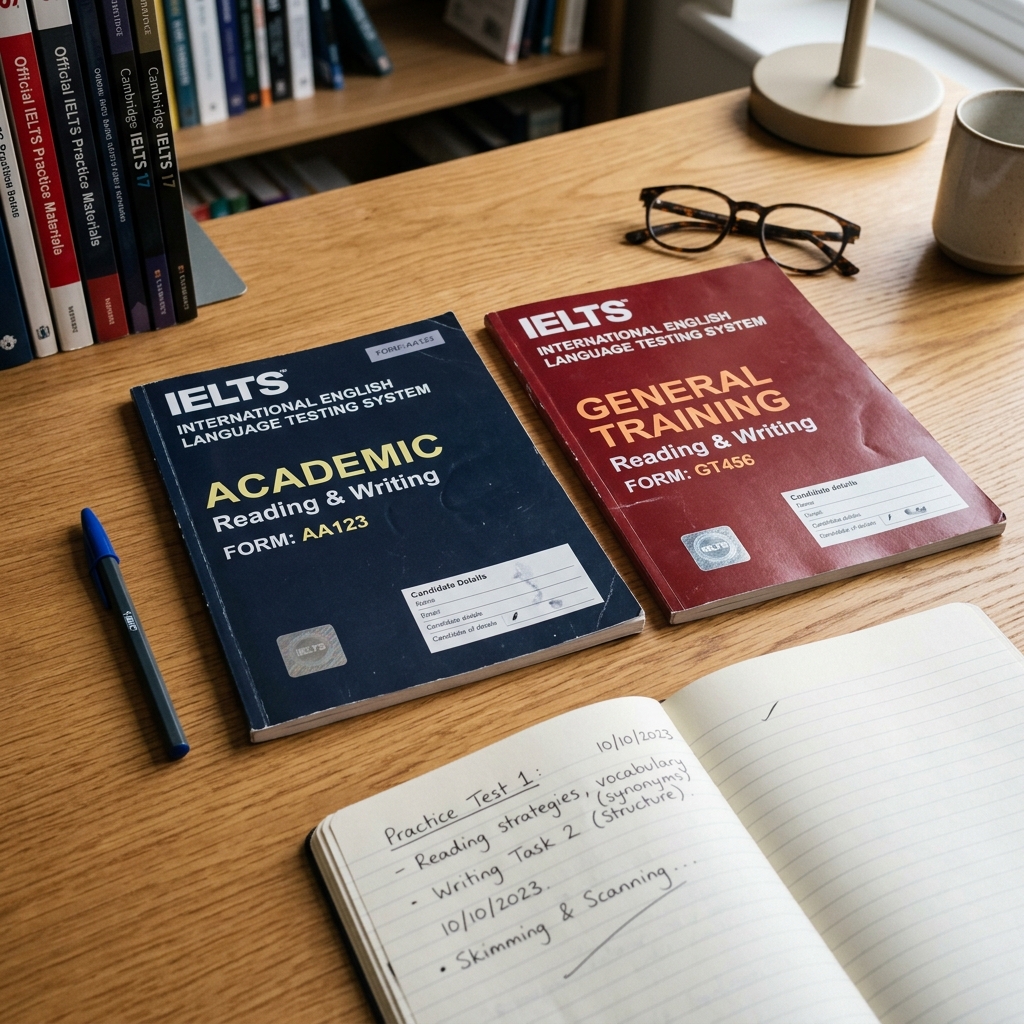
Academic vs. General Training: Who Needs Which?
The choice of exam is determined by the organization receiving your scores (universities, employers, or immigration departments), not by your personal preference.
Who Should Take IELTS Academic?
The Academic test is designed to assess whether your English capability is suited for an academic environment. You must take this version if you are:
- Applying for undergraduate or postgraduate programs at English-speaking universities.
- Seeking professional registration with medical boards in English-speaking countries (e.g. registration as a doctor, nurse, pharmacist, or physiotherapist with the NHS).
- Applying for student visa routes in the UK, Australia, Canada, or the USA.
Who Should Take IELTS General Training?
The General Training test evaluates English proficiency in a broad, social, and workplace context. You should take this version if you are:
- Applying to migrate to Canada (Express Entry), Australia, New Zealand, or the UK.
- Seeking employment or training in an English-speaking country that does not require professional academic registration.
- Applying for secondary education programs in English-speaking environments.
Format Differences Across the Four Modules
The Listening and Speaking modules are identical in both the Academic and General Training versions. However, the Reading and Writing modules are fundamentally different.
| Module | IELTS Academic | IELTS General Training |
|---|---|---|
| Listening | Identical: 4 sections, 40 questions (academic and social contexts). | Identical: 4 sections, 40 questions (academic and social contexts). |
| Reading | 3 long, academic texts (journals, books, magazines) that are analytical and academic. | 5-6 shorter texts (advertisements, workplace handbooks, notices, and one descriptive story). |
| Writing Task 1 | Describe a chart, graph, table, or diagram (minimum 150 words). | Write a formal, semi-formal, or informal letter (minimum 150 words). |
| Writing Task 2 | Write a formal, academic essay responding to a prompt (minimum 250 words). | Write a semi-formal, persuasive essay responding to a prompt (minimum 250 words). |
| Speaking | Identical: Face-to-face interview with an examiner (11–14 minutes). | Identical: Face-to-face interview with an examiner (11–14 minutes). |
The Reading Scoring Difference: A Crucial Warning
A common mistake candidates make is assuming that because the General Training Reading texts are simpler, it is easier to achieve a high band score. In reality, the General Training Reading scale has a much higher grading curve. Because the texts are less complex, you must answer more questions correctly to achieve the same band score as an Academic candidate.
| Targeted Band Score | Academic Reading (Correct Answers out of 40) | General Training Reading (Correct Answers out of 40) |
|---|---|---|
| Band 8.0 | 35 – 36 | 37 – 38 |
| Band 7.5 | 33 – 34 | 36 |
| Band 7.0 | 30 – 32 | 34 – 35 |
| Band 6.5 | 27 – 29 | 32 – 33 |
| Band 6.0 | 23 – 26 | 30 – 31 |
| Band 5.5 | 19 – 22 | 27 – 29 |
For instance, to score a Band 7.0 (a standard requirement for immigration and university admissions), an Academic candidate only needs 30 correct answers, whereas a General Training candidate must achieve at least 34 correct answers.
Writing Task 1: Academic Data vs. General Letters
The most significant format difference lies in Writing Task 1, which tests entirely different writing styles.
Academic Writing Task 1
You are presented with a visual representation of data (such as a bar chart, line graph, process diagram, map, or table). You must write a factual report summarizing the main features, comparing data points, and describing trends without injecting personal opinions.
- Key Skills: Data analysis, describing upward/downward trends, comparing quantities, and outlining industrial processes.
- Key Vocabulary: fluctuated, surged, stabilized, represented, compared to, in contrast.
General Training Writing Task 1
You are presented with a everyday scenario (such as a billing dispute, a job application, or an invitation to a colleague). You must write a letter explaining the situation, addressing three specific bullet points, and using the correct tone (formal, semi-formal, or informal).
- Key Skills: Letter writing structure, opening/closing salutations, and adopting the appropriate tone.
- Key Vocabulary: Dear Sir/Madam, I am writing to complain about..., Yours sincerely, Yours faithfully.
Frequently Asked Questions
Can I use my Academic IELTS scores for immigration?
Generally, yes. Most immigration departments (such as those in Australia, New Zealand, and the UK) accept Academic IELTS scores in place of General Training scores because the Academic test is considered more intellectually demanding. However, Canada's Express Entry program is a notable exception; it strictly requires General Training scores (or CELPIP) for economic migration streams. Always verify requirements with your migration consultant.
Are the Speaking and Listening modules graded differently?
No. Because the Speaking and Listening tests are identical in both versions, they use the exact same grading scales. A raw score of 30 out of 40 in the Listening section yields a Band 7.0 on both the Academic and General Training exams.
How do I check which test I need?
You must verify the requirements directly with the receiving organization. If you are applying to a university, check the international admissions requirements page on their website. If you are applying for a visa, check the official government immigration portal. Never rely on advice from study forums or friends, as requirements change frequently.
How should I format my CV if I am applying for UK jobs after taking the IELTS?
When applying for roles that require sponsorship, ensure your CV is fully localized for the UK market. You can read our guide on how to write a resume for UK Skilled Worker Visa applications to learn about standard UK formats, and verify your document's layout using our ATS Optimizer.
Summary Checklist for IELTS Success
Review this quick guide before registering for your exam:
- Target Organization Verified: You have written confirmation of whether you require Academic or General Training.
- Reading Grading Scale Understood: General Training candidates are aware they need higher raw scores for a Band 7+.
- Task 1 Formats Mastered: Academic candidates can describe data; General Training candidates can write letters.
- No Double Quotes inside Blockquotes: Ensure any quotes or blockquote examples are free of manual double quotes.
- Three Short Tags: The post's frontmatter contains exactly three short, relevant tags.
- Relative Internal Links: All links to the builder, optimizer, and interview coach are relative.
Practice with our AI Mock Interviewer
Simulate real interviews, get instant feedback, and build confidence before the big day.
Start PracticingWritten by
Mehmet Kerem Mutlu
Founder of AlignCV · Mechanical Engineering Student
Mehmet Kerem is a mechanical engineering student and the founder of AlignCV — an AI-powered career platform built to help every job seeker land their next role with confidence. Combining his engineering mindset with a passion for product development, he designs tools that make CV writing, cover letter generation, and interview preparation faster and smarter. He writes about career strategy, AI in hiring, and the future of work.