

Preparing for the IELTS exam while balancing a demanding 40-hour work week is a major challenge. Many working professionals fail to reach their target band scores not due to a lack of English capability, but because they set unrealistic study goals. Attempting to study for three hours every night after a long workday quickly leads to burnout, fatigue, and poor retention.
The key to succeeding in 30 days is structured, time-efficient study. By focusing on exam strategies, mastering structural templates, and scheduling regular diagnostic practice, you can achieve a Band 7+ in under 1.5 hours a day.
If you are preparing for international relocation or study, you can use our CV Builder to format a professional, UK- or US-style resume. To practice answering speaking questions under test-like conditions during your study sessions, rehearse with our interactive AI Interview Coach.
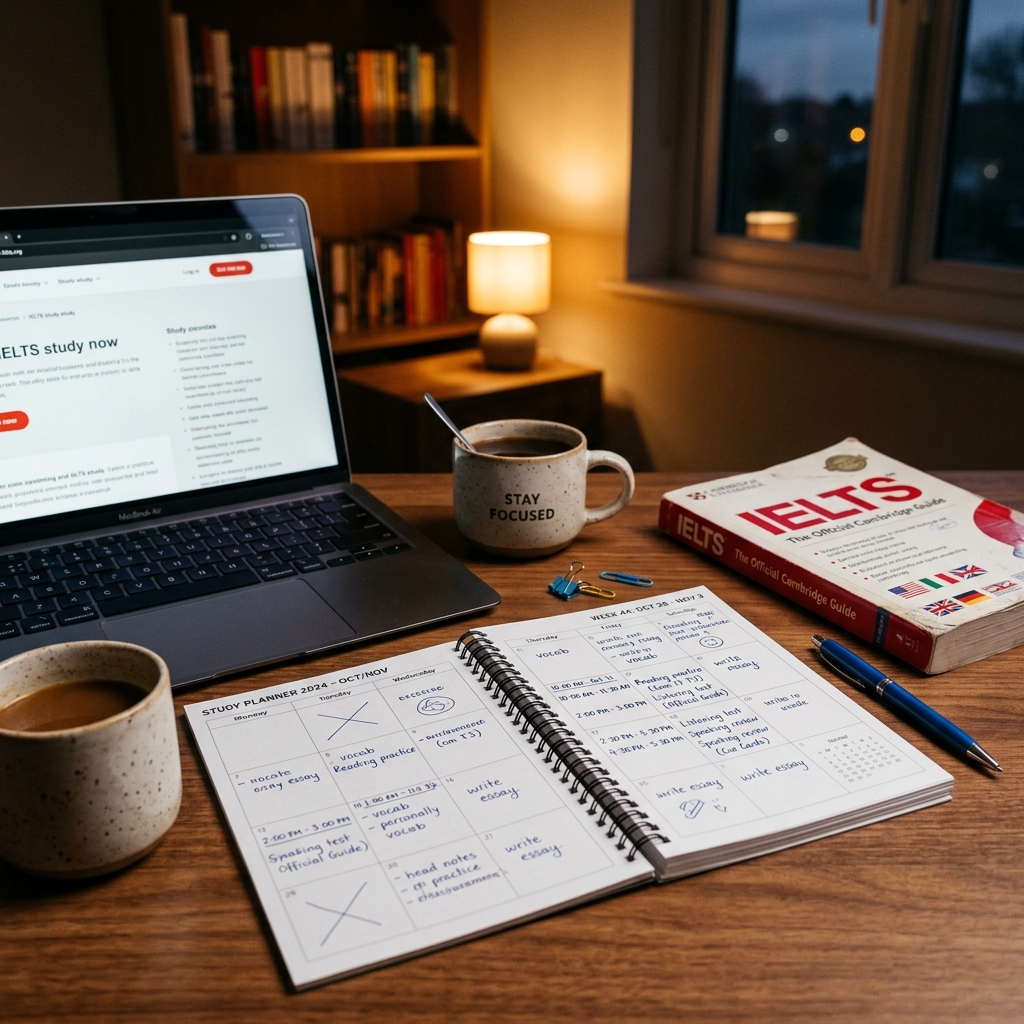
Weekly Study Roadmap
This 30-day plan is structured to build your familiarity with the exam format, teach you specific section strategies, and finalize your test-day timing.
Week 1: Diagnostic Assessment & Format Mastery
- Goal: Understand your starting level and learn the structure of all four modules.
- Actions:
- Take a full-length diagnostic practice test under strict timing to identify your baseline score.
- Analyze your results to identify your weakest module (e.g. Writing Task 2 or Reading True/False/Not Given).
- Register for your exam date to set a firm deadline.
- Learn the general formatting requirements and scoring scales (particularly the differences between Academic and General Training).
Week 2: Input Modules (Listening & Reading)
- Goal: Master the passive comprehension skills and learn to avoid traps.
- Actions:
- Practice active prediction for the Listening fill-in-the-blank questions.
- Master skimming (reading for general meaning) and scanning (searching for specific keywords) techniques for Reading.
- Practice specific Reading question types, focusing on True/False/Not Given strategies.
- Complete three targeted Listening and Reading practice sections, keeping detailed records of your errors.
Week 3: Output Modules (Writing & Speaking)
- Goal: Learn structural templates to save writing time and ensure natural speaking flow.
- Actions:
- Memorize the standard four-paragraph essay template for Writing Task 2.
- Learn the specific structural transitions and vocabulary for Writing Task 1.
- Practice organizing Speaking Part 2 cue cards in under 60 seconds.
- Record yourself speaking for 2 minutes daily, focusing on pacing and reducing filler words like "umm."
Week 4: Full-Length Simulation & Fine-Tuning
- Goal: Build endurance and finalize your test-day timing.
- Actions:
- Complete two full-length practice tests under strict exam conditions (no pauses, no dictionaries).
- Review your essay drafts against the official band descriptor checklists.
- Re-review your personal error log, focusing on spelling mistakes or timing bottlenecks.
- Rest your mind two days before the exam; do not attempt last-minute cramming.
A Realistic Daily Study Schedule
For a working professional, consistency is more valuable than cramming. Structure your week around these micro-study blocks:
| Day | Study Focus | Time Commitment | Study Session Details |
|---|---|---|---|
| Monday | Reading Practice | 45 minutes | Complete one Reading passage (20 mins) + review errors (25 mins). |
| Tuesday | Listening Practice | 45 minutes | Complete one Listening section (30 mins) + log spelling errors (15 mins). |
| Wednesday | Writing Practice | 60 minutes | Draft one Writing Task 2 essay using the four-paragraph template. |
| Thursday | Speaking Practice | 45 minutes | Rehearse three Speaking Part 2 cue cards using audio recording. |
| Friday | Error Log Review | 30 minutes | Review grammar mistakes and spelling traps from the week. |
| Saturday | Full-Length Practice | 3 hours | Complete a full exam simulation (Reading, Listening, Writing) under time pressure. |
| Sunday | Rest & Recharge | 0 minutes | Rest completely to avoid cognitive fatigue. |
3 Tips to Maximize Study Efficiency
1. Leverage Your Daily Commute (Passive Learning)
Use your daily travel time to build your vocabulary and listening comprehension. Listen to English-language podcasts (such as BBC, NPR, or TED Talks) or read high-quality journalism (such as The Economist or New Scientist). This exposes you to advanced vocabulary and structural markers naturally.
2. Focus heavily on templates to save time
Do not try to invent a new structure during the writing exam. By mastering the standard IELTS Writing Task 2 essay structure beforehand, you can automatically format your introduction and body paragraphs, saving up to 10 minutes that can be redirected to proofreading your grammar.
3. Maintain a Personal Error Log
Keep a notebook or spreadsheet dedicated to your mistakes. For every practice test, record the misspelled words, missed singular/plural endings, and grammatical errors. Review this log every Friday to ensure you do not repeat the same errors on test day.
Frequently Asked Questions
Can I really get a Band 7.0 in 30 days starting from scratch?
If your current English level is intermediate (around B2 level), achieving a Band 7.0 in 30 days is highly realistic by focusing on exam strategies. However, if your baseline level is beginner or lower-intermediate (A2/B1), you will likely need to spend 2 to 3 months building your core English vocabulary and grammar before focusing on IELTS-specific strategies.
How do I evaluate my writing practice if I am studying alone?
Compare your practice essays against the official IELTS Band descriptors for Task Achievement and Coherence. Check if you have a clear introduction, two distinct body paragraphs, a conclusion, and a clear thesis statement. Alternatively, you can use specialized online feedback tools or tutors to receive graded feedback.
Should I study vocabulary lists?
Memorizing long lists of random words is inefficient. Instead, learn vocabulary in context by grouping words by common IELTS topics (such as Technology, Education, Environment, and Health). Learn how to use these words in sentences, paying attention to collocations (words that naturally go together).
30-Day IELTS Study Checklist
Ensure your study plan covers these essential bases:
- Diagnostic Test Completed: Baseline score and weak areas are identified.
- Daily Study Blocks Scheduled: 45–60 minute sessions are locked into your calendar.
- Essay Templates Memorized: Outlines for Writing Task 1 and Task 2 are mastered.
- No Double Quotes inside Blockquotes: Ensure blockquote examples do not contain manual double quotes.
- Three Short Tags: The post's frontmatter contains exactly three short tags.
- Relative Internal Links: Verify links point correctly to the builder, optimizer, and interview coach.
Practice with our AI Mock Interviewer
Simulate real interviews, get instant feedback, and build confidence before the big day.
Start PracticingWritten by
Mehmet Kerem Mutlu
Founder of AlignCV · Mechanical Engineering Student
Mehmet Kerem is a mechanical engineering student and the founder of AlignCV — an AI-powered career platform built to help every job seeker land their next role with confidence. Combining his engineering mindset with a passion for product development, he designs tools that make CV writing, cover letter generation, and interview preparation faster and smarter. He writes about career strategy, AI in hiring, and the future of work.