
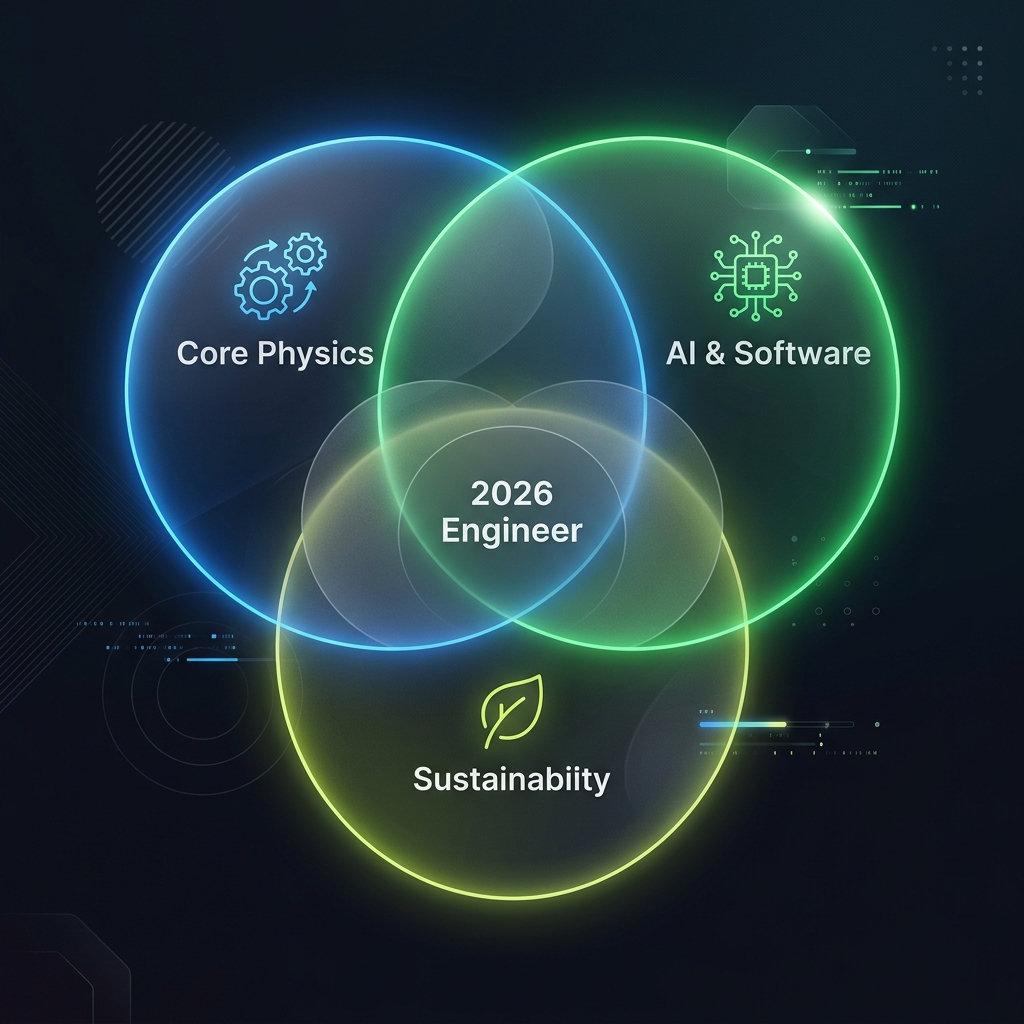
In 2026, the identity of the "Mechanical Engineer" is undergoing a profound transformation. While the laws of thermodynamics and the principles of fluid mechanics remain unchanged, the tools used to apply them have shifted from traditional CAD to Generative Design, Digital Twins, and AI-driven Simulation.
If you are a graduate walking into an interview with a global automotive giant, an aerospace firm, or a sustainable energy startup, you will notice a shift. Employers are no longer testing your ability to memorize formulas—they are testing your First Principles Thinking in an environment where AI handles the routine calculation.
In this 3,000-word masterclass, we will provide you with the technical logic, behavioral strategies, and 2026-specific insights you need to land your dream role. We will explore how to answer complex technical questions and how to use the STAR-Impact Method to turn your academic projects into professional proof of value.
Part 1: The 'First Principles' Foundation
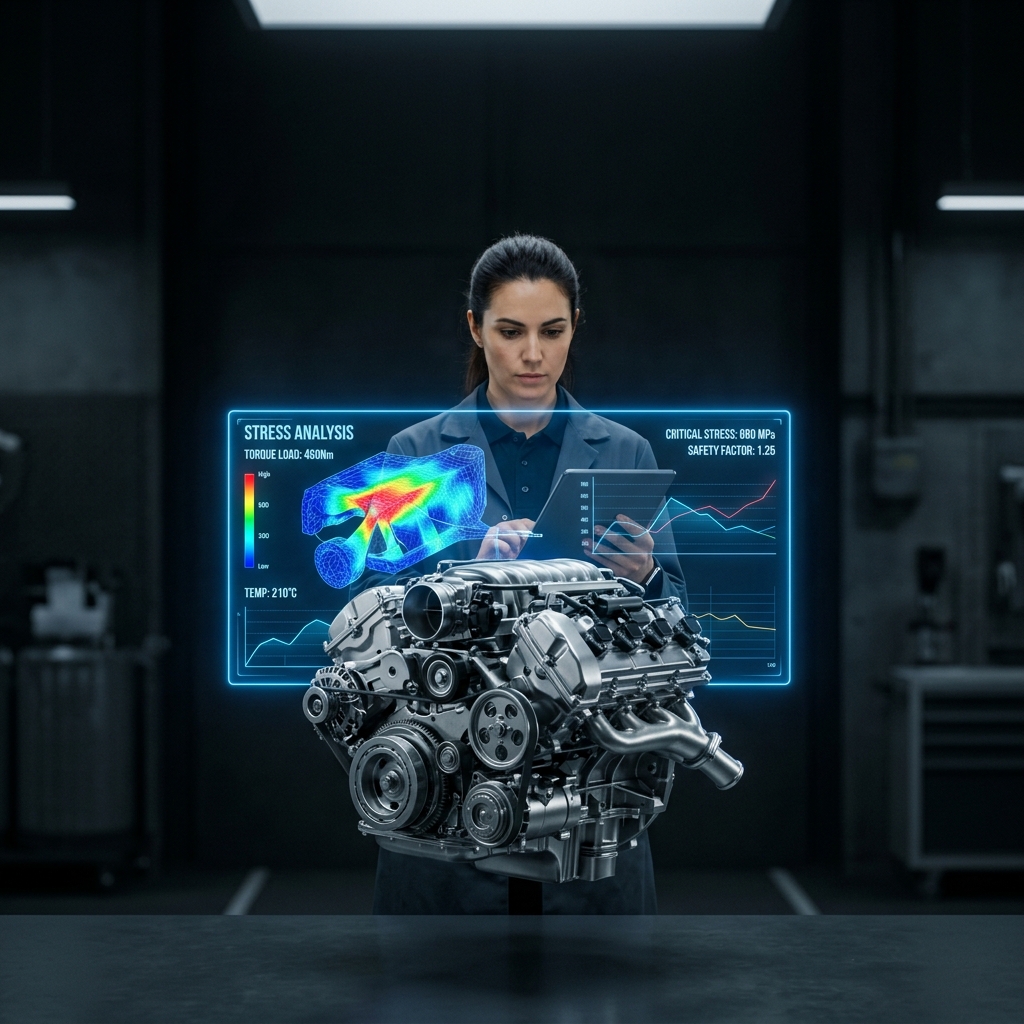
AI can optimize a design, but it cannot replace the human understanding of physics. In 2026, the highest-performing engineers are those who can "sanity-check" an AI's output using first principles.
Why First Principles Matter
Recruiters at top firms like ASME (American Society of Mechanical Engineers) often warn that graduates are becoming too dependent on software. During your interview, show that you can:
- Visualize the Problem: Draw a free-body diagram before discussing the FEA (Finite Element Analysis) results.
- State Your Assumptions: Explicitly identify the constraints, material properties, and environmental factors.
- Reason from Logic: Explain why a beam will fail at a certain point, rather than just stating the software's predicted stress value.
Part 2: The New Frontier — AI, Robotics, and Digital Twins
As a junior engineer in 2026, you will likely work alongside AI agents. You need to demonstrate that technology is a "force multiplier" for your creativity.
1. Generative Design and Optimization
Be prepared to answer: "How would you use generative design to reduce the weight of a component without compromising structural integrity?" The 2026 Answer: Focus on specifying the correct constraints and load cases for the AI to process, followed by an iterative validation process using traditional simulation.
2. Digital Twins and Predictive Maintenance
Companies are now using Digital Twins to monitor real-time performance. Question: "How does a Digital Twin improve the lifecycle of a mechanical system?" Answer: "By creating a virtual replica of the physical asset, we can ingest real-time sensor data to predict failures before they occur. This shifts our strategy from reactive repair to Predictive Maintenance, significantly reducing downtime and operational costs."
Part 3: Behavioral Questions — The STAR-Impact Engineering Model
Engineering is a team sport. Behavioral questions test your ability to communicate, adapt, and learn from failure.
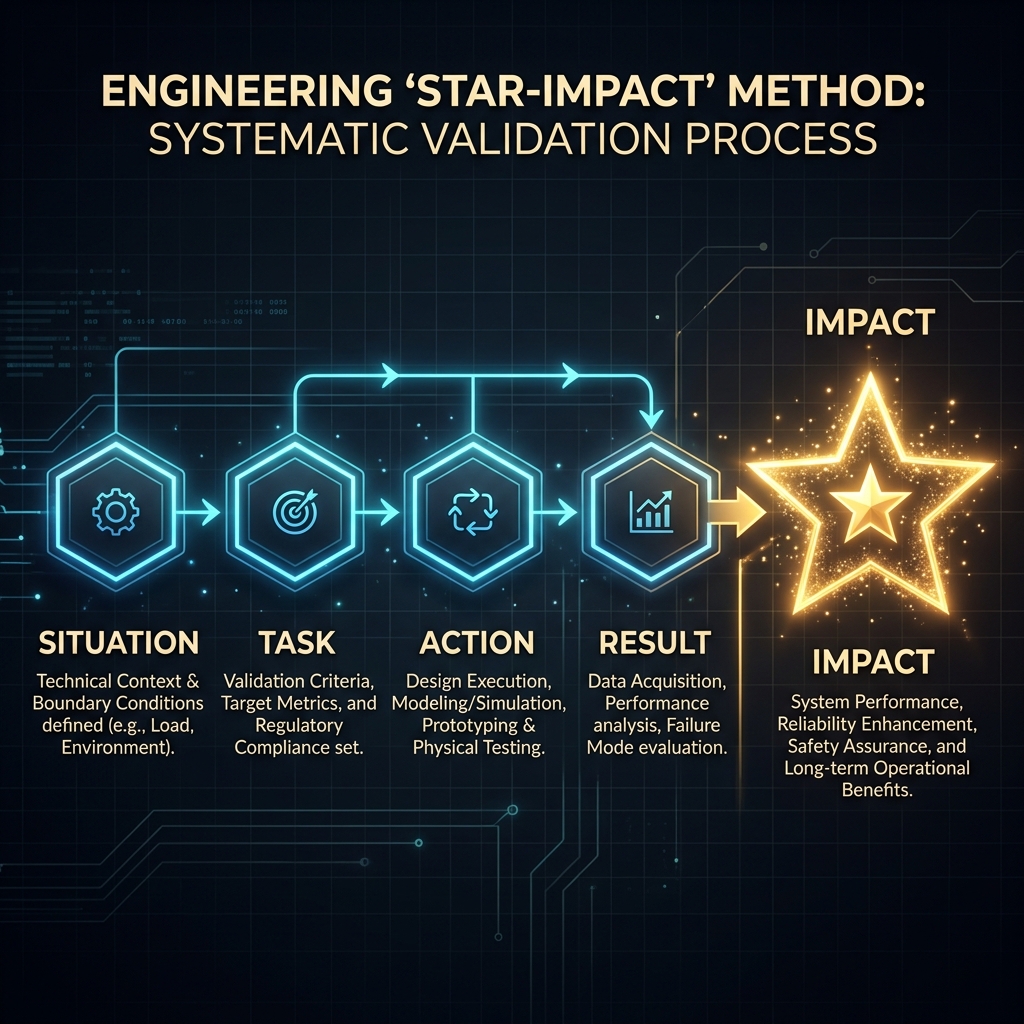
The STAR-Impact Method
- Situation: The project or technical challenge.
- Task: Your specific engineering goal.
- Action: The technical steps you took (mention specific software or physics principles).
- Result: The numerical outcome.
- Impact: The business or environmental value (e.g., cost saved, carbon reduced).
Sample Question: "Tell me about a time a design project failed."
During my formula student project, our initial cooling system failed during a high-speed test (Situation). I was responsible for the heat exchanger redesign (Task). I performed a root-cause analysis using Computational Fluid Dynamics (CFD) and found a cavitation issue in the pump (Action). I redesigned the impeller geometry, which lowered the operating temperature by 15% (Result). This success ensured the car finished the endurance race, securing our team's first top-10 finish and teaching me the importance of validating fluid-structure interactions early in the design cycle (Impact).
Part 4: Top 10 Technical Questions & Expert Answers
Q1: "Explain the Second Law of Thermodynamics as if I'm a non-technical stakeholder."
Answer: "Think of it as the 'Tax of Nature.' Every time energy is converted from one form to another—like fuel into motion—some of it is 'lost' as heat. It tells us that we can never have a 100% efficient machine; there is always a natural push toward disorder (entropy)."
Q2: "What criteria would you use to select a material for a high-temperature aerospace component?"
Answer: "I would look at the Strength-to-Weight Ratio, the Melting Point, Thermal Expansion coefficients, and Creep Resistance. For 2026 standards, I would also perform a Life Cycle Assessment (LCA) to evaluate the environmental footprint of extracting and processing that material."
Q3: "What is the difference between Stress and Strain?"
Answer: "Stress is the internal force acting within the material (the 'Pressure'), while Strain is the physical deformation resulting from that force (the 'Stretch')."
Part 5: The Sustainable Engineer — Designing for Net Zero
In 2026, sustainability is a core engineering requirement, not an afterthought.
Designing for Circularity
You may be asked how to design a product for "End-of-Life." Focus on Modularity and Recyclability. Show that you understand how to design systems that can be easily disassembled and repurposed, aligning with global Net Zero targets.
Part 6: Standing Out with AlignCV
A world-class mechanical engineer needs more than just a degree—they need a professional brand that signals "2026-Ready."
Practice with our AI Interview Coach
Our AI Interview Coach has been fine-tuned with technical rubrics from leading engineering firms. You can:
- Practice explaining Thermodynamics to non-technical managers.
- Get feedback on your STAR-Impact stories.
- Simulate high-pressure technical "whiteboard" sessions.
Build an Engineering CV That Passes the ATS
Engineering recruiters use specialized filters for software (SolidWorks, ANSYS, MATLAB) and certifications.
- Use our ATS CV Builder to ensure your technical skills are mapped correctly.
- Learn How to Write an ATS-Friendly CV to highlight your impact over simple task lists.
- Avoid Buzzword Stuffing and focus on your actual CAD/Simulation projects.
Final Thoughts: The Responsibility of the Maker
Mechanical engineering is where the digital meets the physical. In 2026, your responsibility as a graduate is to ensure that the systems we build are not only efficient and powerful but also Sustainable and Ethical.
When you walk into that interview, show them that you have the hands-on skills of a builder, the analytical mind of a scientist, and the vision of a 21st-century technologist.
Your career in the future of engineering starts here.
Practice with our AI Mock Interviewer
Simulate real interviews, get instant feedback, and build confidence before the big day.
Start PracticingWritten by
Mehmet Kerem Mutlu
Founder of AlignCV · Mechanical Engineering Student
Mehmet Kerem is a mechanical engineering student and the founder of AlignCV — an AI-powered career platform built to help every job seeker land their next role with confidence. Combining his engineering mindset with a passion for product development, he designs tools that make CV writing, cover letter generation, and interview preparation faster and smarter. He writes about career strategy, AI in hiring, and the future of work.