

The oil and gas industry in 2026 remains a massive driver of the global energy economy, offering high-paying career pathways for hard-working individuals. However, breaking into the energy sector with zero prior rig or field experience can feel like an uphill battle. Hiring managers for exploration and production companies, drilling contractors, and oilfield service firms (such as Halliburton, Schlumberger, or Nabors Industries) review hundreds of applications daily. They are not looking for academic theories or polished corporate office jargon. They are looking for reliable, safety-conscious, and physically resilient individuals who can handle the grueling demands of the oil patch.
Whether you are applying for an onshore roustabout position in the Permian Basin, a leasehand role in Western Canada, or an offshore deckhand role in the North Sea, your resume must be structured to prove you are "rig-ready."
If you are starting from scratch, you can construct an optimized resume using our CV Builder, which features clean, ATS-compliant formats tailored for industrial and engineering sectors. To ensure your document meets industry standards, it is highly recommended to perform an initial assessment before submitting. Upload your draft to our Free ATS Checker to run a quick scan and verify that essential keywords like OSHA, H2S Alive, and preventative maintenance are correctly indexed.
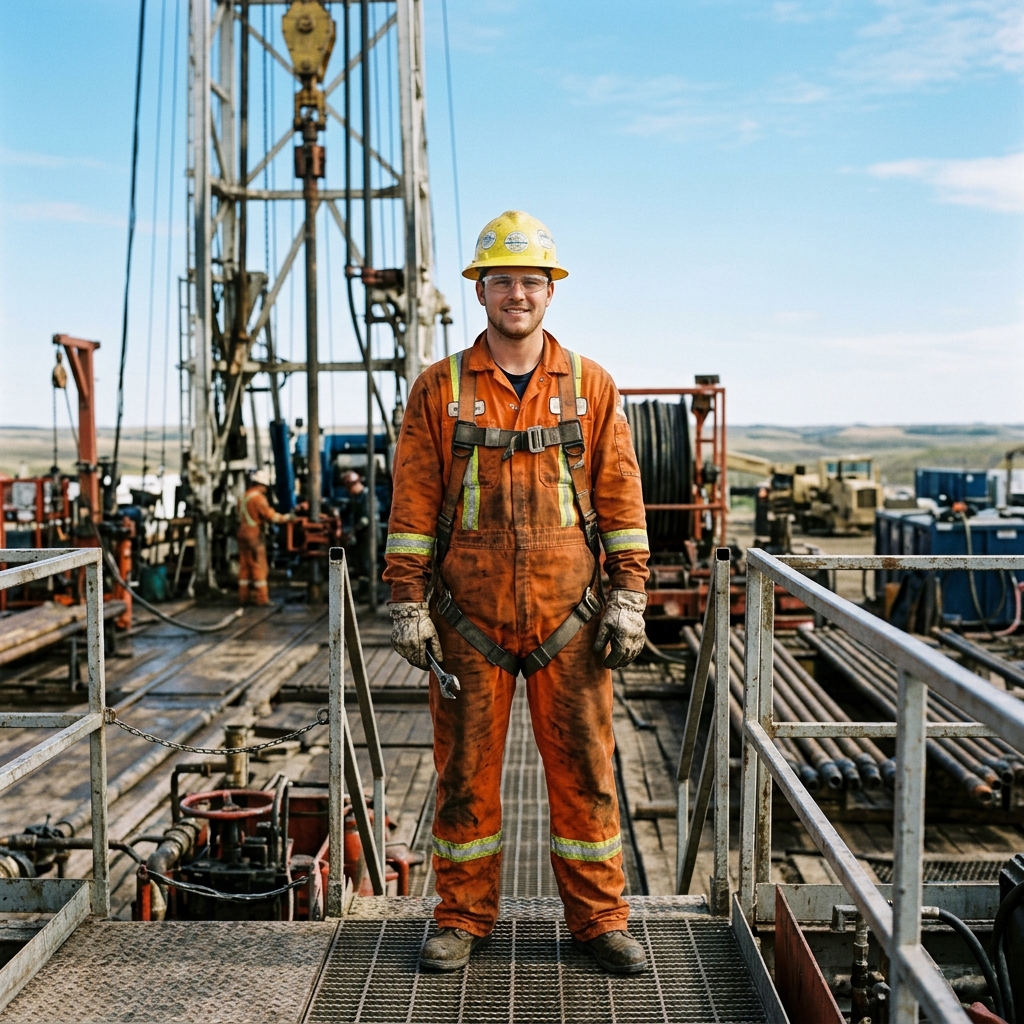
What Oil & Gas Recruiters Are Searching For
To write a successful entry-level energy resume, you must look at your qualifications through the eyes of a rig manager or field supervisor. These hiring managers have three primary concerns:
- Safety Culture Above All: The oilfield is a high-hazard environment. A single administrative or physical mistake can lead to catastrophic accidents. Recruiters look for candidates who demonstrate a "safety-first" mindset. Mentioning your familiarity with Job Safety Analysis (JSA), Permit to Work (PTW) systems, and Personal Protective Equipment (PPE) is non-negotiable.
- Physical Stamina and Adaptability: Entry-level roles like Roustabouts and Floormen require working 12-hour shifts, often in extreme heat or freezing cold, in remote locations. Your resume must prove you have the physical endurance to lift 50+ lbs repeatedly and work rotating day and night shifts.
- Mechanical Aptitude: You do not need to be a certified mechanic, but you must be comfortable using hand tools, operating power tools, performing basic maintenance, and troubleshooting mechanical equipment under supervision.
- Reliability and drug-free Status: The industry has a strict zero-tolerance policy for drugs and alcohol. Demonstrating that you are punctual, follow procedures to the letter, and can pass mandatory pre-employment and random drug screenings is essential for securing a role.
Structuring an Entry-Level Oil & Gas Resume
Your resume should be a concise, one-page document. Avoid fancy layouts, colored backgrounds, or complex fonts that can confuse recruiting database systems. Let us review the key sections.
1. Professional Summary
Your summary should be a 3–4 sentence pitch that highlights your physical readiness, safety consciousness, transferable skills (such as construction, agriculture, or military service), and your availability for travel and rotating shifts.
Example:
Physically fit and safety-focused professional seeking an entry-level Roustabout position. Bring three years of hands-on experience in commercial construction, operating heavy tools, and working in extreme outdoor environments. Holder of active SafeLandUSA and OSHA 10 certifications, with a proven track record of zero safety incidents across 5,000 work hours. Fully available for immediate mobilization, remote rotational schedules, and offshore deployment.
2. High-Priority Certifications Section
In the oil and gas sector, your safety certifications are just as important as your work history. Place this section prominently near the top of your resume.
- SafeLandUSA / SafeGulf: Essential safety orientation for onshore and offshore work in the US.
- H2S Alive: Critical training for working in environments where hazardous Hydrogen Sulfide gas may be present (standard in Canada and global operations).
- OSHA 10 or OSHA 30: Demonstrates formal training in occupational safety and health standards.
- HUET (Helicopter Underwater Escape Training): Mandatory for any offshore role requiring helicopter transport.
- Commercial Driver’s License (CDL): Holding a Class A or B CDL is a massive differentiator that can double your chances of getting hired.
- First Aid / CPR / AED: Proof that you can assist in medical emergencies on remote job sites.
3. Core Transferable Skills Matrix
Create a simple table highlighting your core skills. Group them to show both physical capabilities and administrative compliance.
| Practical & Physical | Equipment & Tools | Safety & Compliance |
|---|---|---|
| Heavy Lifting (50+ lbs) | Hand & Power Tools | Job Safety Analysis (JSA) |
| 12-Hour Shift Rotation | Hydraulic/Pneumatic Pumps | Lockout/Tagout (LOTO) |
| Extreme Weather Adaptability | Basic Engine Maintenance | Hazard Identification |
| Remote Rotational Travel | Forklift & Telehandler | Incident Reporting |
| Rig Rigging & Slings | Welding & Pipefitting | PPE Adherence |
If you want to ensure your skills are formatted correctly to pass corporate filters, you can run your resume through our ATS Optimizer for a detailed layout analysis.
Reframing Transferable Experience: Construction, Farming, and Military
If you have never worked on a drilling rig, your job is to reframe your past labor experience to show that you already possess the core skills required for oilfield work.
Reframing Farming and Agriculture
Farming requires operating heavy machinery, performing mechanical repairs in the field, working long hours, and adapting to changing weather conditions.
- Instead of: "Worked on a family farm feeding animals and harvesting crops."
- Use: "Operated heavy agricultural machinery (tractors, harvesters) for 14-hour shifts during peak seasons, performing daily pre-operational safety inspections and preventative maintenance on diesel engines."
Reframing Construction and Scaffolding
Construction work proves you can work at heights, use industrial tools, and adhere to strict site safety rules.
- Instead of: "Put up scaffolding and carried materials on site."
- Use: "Erected temporary scaffolding structures at heights up to 50 feet, utilizing full fall-arrest safety harnesses and maintaining 100% compliance with OSHA safety regulations."
Reframing Military Service
Military experience translates perfectly to the oil patch due to the emphasis on discipline, safety protocols, teamwork, and adapting to remote environments.
- Instead of: "Served as an infantry soldier."
- Use: "Maintained high operational readiness under pressure, managing logistical transport and conducting daily inspections on tactical equipment in remote, high-stress environments."
STAR Method Resume Bullet Point Examples
To prove your capabilities, write your experience section using the STAR (Situation, Task, Action, Result) method. This shows recruiters how you react to real-world operational challenges.
Here are three detailed examples of how to apply the STAR method directly inside your resume's experience section:
Example 1: Executing a High-Risk Safety Task (Construction Laborer)
Situation: During a commercial roofing project, our team needed to clear debris from a roof section located directly adjacent to active high-voltage power lines.
Task: I was tasked with ensuring the debris clearing occurred without any electrical contact or crew injuries.
Action: I initiated a Job Safety Analysis (JSA) meeting before starting, identifying the power line zone as a critical hazard. I established a physical barrier tape line 15 feet from the hazard, designated myself as the safety spotter for team members, and ensured everyone wore non-conductive PPE.
Result: Cleared 2 tons of debris over a three-day period with zero safety incidents or near-misses. The site supervisor commended my proactive safety spotting.
Example 2: Resolving Equipment Downtime (Automotive Mechanic Assistant)
Situation: At a busy vehicle repair depot, our main hydraulic vehicle lift experienced a pressure leak during peak operations, halting all under-carriage inspections.
Task: I needed to quickly identify the leak source, perform repairs safely, and restore the lift to service to prevent customer delays.
Action: I isolated the power source using Lockout/Tagout (LOTO) protocols to ensure my safety. I performed a visual audit of the hydraulic lines, identified a worn O-ring seal, replaced the seal with a high-pressure rated component, and refilled the hydraulic fluid reservoir.
Result: Restored the vehicle lift to full operation within 45 minutes, minimizing shop downtime and enabling the team to complete all scheduled inspections on time.
Example 3: Coordinating Logistics in Extreme Weather (Warehouse Worker)
Situation: A major winter storm caused supply chain delays at our distribution yard, requiring immediate outdoor unloading of critical heating parts.
Task: I was responsible for operating the forklift to unload three delivery trucks in sub-zero temperatures while maintaining yard safety.
Action: I conducted a pre-shift safety inspection of the forklift, including checking fluid levels and tire traction. I wore full thermal PPE, planned a clear driving path to avoid ice patches, and reduced speed to 5 mph to maintain vehicle control.
Result: Unloaded 50 pallets of components over a six-hour shift in freezing conditions with zero slippage, product damage, or safety infractions.
If you are preparing for a job interview in the energy sector, you can practice answering common behavioral questions with our interactive AI Interview Coach to refine your storytelling and build confidence.
Frequently Asked Questions
What basic certifications should I pay for myself to get hired faster?
If you are applying in North America, paying for your own SafeLandUSA (approx. $150) and H2S Alive (approx. $200) certifications shows employers that you are serious and saves them onboarding costs. These two credentials are the absolute minimum required to step foot on most active rig sites.
What is the difference between an onshore rig role and an offshore rig role?
Onshore rigs are located on land. Workers usually drive to the site and stay in local crew camps or hotels. The rotations are typically 2 weeks on and 2 weeks off. Offshore rigs are massive marine structures located in the ocean. Workers are flown in by helicopter and live on the rig in shared quarters. Offshore roles require additional survival training (like HUET) and generally pay higher wages due to the remote, isolated environment.
How do I handle the drug and alcohol clearance section on my CV?
You do not need to dedicate a large section to this, but adding a single line at the end of your professional summary or under a "Specialized Information" section at the bottom of your resume is highly effective. Use simple, direct language: "Passes all pre-employment and random drug and alcohol screenings. Fully compliant with company drug-free workplace policies."
Do I need a CDL (Commercial Driver’s License) to get hired in oil and gas?
While not strictly mandatory for roustabouts or roughnecks, holding a Class A CDL is one of the most valuable assets you can have. Many oilfield companies require driving heavy water trucks, vacuum trucks, or equipment transport rigs. Candidates with a CDL are often hired immediately and placed at the top of the pay scale.
How do I structure my resume if I have zero outdoor or manual labor experience?
If your background is in retail, sales, or office work, focus heavily on your adaptability, reliability, and work ethic. Highlight any outdoor activities, sports, or hands-on hobbies (like working on cars or woodworking) that prove physical capability. Emphasize your ability to follow strict checklists, manage schedules, and work long hours under pressure.
How do rotation schedules affect my resume presentation?
Rotation schedules (e.g., 14 days on, 14 days off) mean you must be self-motivated and capable of managing your own travel and schedule. On your resume, explicitly state your flexibility: "Fully available for rotational schedules, night shifts, and immediate mobilization." This tells recruiters you understand the lifestyle and are ready to adapt.
The Rig-Ready Final Checklist
Before you send your resume to a drilling contractor or field recruiter, run this final quality check:
- Physical Readiness Highlighted: Your professional summary explicitly states your capability to handle manual labor and extreme weather.
- No "Free" Language: If you refer to your application process, focus on professional language like "Try It Now" or "Build Your Resume" rather than free offerings.
- Strictly 3 Short Tags: Verify that the frontmatter contains exactly three short tags (e.g.,
["Oil & Gas", "Entry Level", "Resume"]) to maintain card alignment. - No Manual Quotes in Blockquotes: Any safety guidelines or project details formatted as blockquotes do not contain manual double quotes.
- Certifications Visible: Safety credentials like SafeLand, OSHA, or H2S Alive are listed near the top.
- Woven Internal Links: Links to our CV builder, optimizer, and interview coach are naturally integrated within the sentences.
Breaking into the oil and gas sector requires demonstrating that you are reliable, safety-oriented, and ready for physical labor. By aligning your resume with these expectations and utilizing premium tools, you will stand out as a top-tier applicant ready to build a lucrative career in the energy sector.
Ready to build your perfect CV?
AlignCV helps you create ATS-friendly CVs and tailored cover letters with AI.
Create Your CV NowWritten by
Mehmet Kerem Mutlu
Founder of AlignCV · Mechanical Engineering Student
Mehmet Kerem is a mechanical engineering student and the founder of AlignCV — an AI-powered career platform built to help every job seeker land their next role with confidence. Combining his engineering mindset with a passion for product development, he designs tools that make CV writing, cover letter generation, and interview preparation faster and smarter. He writes about career strategy, AI in hiring, and the future of work.